Read Continental Caper
Continental Caper Photo Gallery
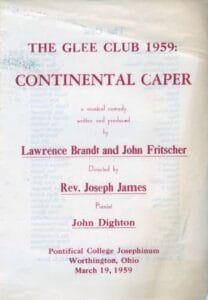
Continental Caper
A Musical Comedy
Written and Produced by Jack Fritscher and Lawrence Brandt
March 19, 1959
Pontifical College Josephinum
Worthington, Ohio
The Glee Club 1959
Directed by Rev. Joseph James
Pianist: John Dighton
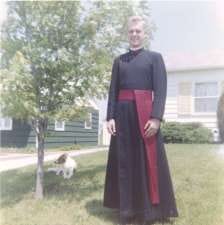
Lawrence Brandt seminarian
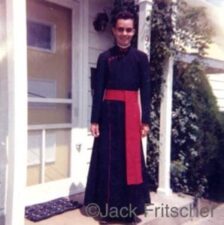
Jack Fritscher seminarian
When I was a 14-year-old freshman in 1953, I couldn’t wait to join the Glee Club at the Pontifical College Josephinum, a Catholic seminary in Ohio directly subject to the Pope in Rome. Our Glee Club included, from our student body of 500 boys age 14-25, an ever-changing annual 50 or so students ranging from high-school freshmen to college sophomores. Every year, a certain clique of older seminarians wrote a Glee Club Show that had to be a musical comedy whose plot and song lyrics could have no mention of women. By 1957, as a high-school senior and a young writer being published for the first time in the Catholic press, I had been in four Glee Club shows. That made me hungry to write the next year’s Glee Club show. But I was not part of the very closeted clique of older Broadway Babies who always passed the writing of the show to the next generation of their young recruits. I knew I had no chance against closeted establishment church queens.
So I asked one of my best friends, Lawrence Brandt (1939-2009), if he’d like to play Rodgers and Hammerstein or Lerner and Lowe with me? He who would grow up to be the beloved Bishop of the Greensburg Diocese in Pennsylvania, was a go-getter who said Yes. Larry was one of those golden-boy seminarians, handsome, blond, extremely intelligent, and one of the leaders of our class. He was always strategic, which later helped him in his Roman career at the Vatican, so he was eager just for the fun of it to wrest power from the Glee Club oligarchs.
As recorded in my Journal (1958-1959) containing the backstory of our backstage drama, Larry and I spent over a year of our free-time on Wednesday and Saturday afternoons closeted away in a deserted classroom while our classmates played ball games outside. We thought it crucial not to tell anyone, not even, Father Joseph “Jimmy” James, the priest-director of the Glee Club concerts and show, who was a real piece of work. We aimed our Continental Caper for the March 1959 Glee Club show. We’d watched All About Eve. We knew what kind of trouble we young rebels faced. It was the conformist 1950s and I was a James Dean teen. We didn’t conform or care, but no one could tell by looking. During 18 months of clandestine creativity, we had a blast thinking up plot, dialogue, characterizations, and folk and pop songs whose lyrics we had to scrub of references to women or romance because, you know, school rule, priestly purity. We were forbidden to have “special friendships” in the seminary, but if you really want to know somebody, hide away with them and write a play.
We were so on top of our writing and our intention to produce our show ourselves, we shared one of the happiest intervals we two ever had together in our lifelong friendship that continued across oceans and continents until Larry’s death. We flipped a dime to fix our billing. Larry won. I still have the dime taped in my Journal. As happened, Larry was straight, and I was an innocent only slightly aware I might be gay. It never came up. It didn’t matter—except for the gay verve I innocently deployed into the script.
Finally, came the day, January 21, 1959, when we two teenagers knocked on Father Jimmy James’ door and announced, “We’ve written next year’s Glee Club play.” He and the cliques hit the seminary ceiling. What jealousy. So much for Christian charity among young seminarians who would be priests. After reading our script and the replacement lyrics I had written—Larry couldn’t do lyrics, the Reverend Jimmy James calmed down and admitted we had a great musical play for 50 boys, including a chorus of 39. Then we shocked them all when we said that Larry and I would not be playing the leads, would not, in fact, appear on stage until the curtain call. Unlike the clique, we had no intention of starring in our own show. Actually, to my regret, I was terrified to get on stage singing and dancing in front of 500 adolescent straight boys whose pubescent gaydar could so quickly shout names at queers when they spied a wrong gesture or posture. The only time homosexuality was mentioned in my ten years there, a priest told us in an all-school assembly, “When you travel home for Christmas, if a queer comes up to you in a bus station toilet, kick him in the balls, and run.”
Actually, I think Jimmy James and the usurped queens were relieved they didn’t have to come up with yet another annual show. Even so, some of them who were only one and two years away from ordination to the priesthood, demanded that they would produce the show. They gave Larry and me attitude for days. Every rehearsal, they blew their noses on us. Like who did we think we were? One queen told me when I suggested a stage direction, “What do you know? You’re only the writer.” Later, I had to go to confession for my uncharitable response. Sorry. Not sorry.
So on the night of March 19, 1959, our musical comedy, Continental Caper, premiered to an audience of 500 boys as the first play staged in the new auditorium that has since been named in honor of my writing mentor for ten years, the Reverend Leonard J. Fick. It was also closing night for the show intended to light up one-night only. During the performance, the audience laughed, cheered, and applauded while the little band combo we assembled played the score: piano, drums, bass. When the auditorium of seminarians began calling out “Author! Author!” Larry and I walked out on stage, took a bow, waved, and thanked our lucky stars we had bucked the establishment then as we would both do later in life.