Take 3: Dureau on Dureau Video Vérité (Part 1)
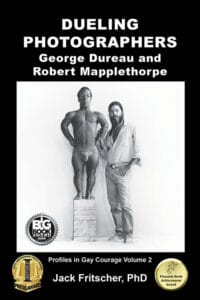

WINNER! 2025 Independent Press Award – LGBT Non-Fiction
SILVER: 2025 NYC Big Book Award – LGBT Non-Fiction
WINNER 2025 Pinnacle Books Achievement Award
This George Dureau video interview, recorded by Jack Fritscher on the second-floor porch balcony of Dureau’s home overlooking the French Quarter on Monday, April 8, 1991, is Take 3, Part 1, of Dueling Photographers: George Dureau and Robert Mapplethorpe. In the first half of a session that ran from 6 to 8:30 PM, the New Orleans painter and photographer traces his path from abstract painter to Baroque figurative artist, explains why he draws before he photographs, and describes his Hasselblad and $68 Mamiya cameras. He also talks about directing models, black-and-white photography, Piero della Francesca, McLuhan’s hot and cool media, and his dual reputation as painter and photographer. The interview continues in Part 2.
Continue to Part 2
- Dueling Photographers by Jack Fritscher
- From Abstract Painter to Baroque Figures
- How Photography Grew Out of Drawing
- Black-and-White Photography, Film and Moonlight
- Directing Models and Avoiding the Darkroom
- Lenses and the $68 Mamiya
- Piero della Francesca and the Painted-Canvas Backdrops
- Dureau on Video and McLuhan’s Hot and Cool Media
- Painter or Photographer? Dureau’s Dual Reputation
Monday, April 8, 1991
6 PM-8:30 PM
EXT. NEW ORLEANS. TWILIGHT.
THE SECOND-FLOOR PORCH BALCONY
OF GEORGE DUREAU.
OVERLOOKING THE FRENCH QUARTER
From Abstract Painter to Baroque Figures
Jack Fritscher: You are known as a photographer, but you began basically as a painter.
George Dureau: I’ve always been a painter. As a child, I drew things that children draw. My mother told me to draw courtyard scenes, magnolias, and I drew them. I didn’t have any art training in high school at all. When I went to college, I studied all abstract things. I became an abstract painter. In the late 1940s and 1950s, I did very non-objective sort of Paul Klee, Miró things. Just when the whole world was convinced that’s what they wanted, I was convinced I didn’t want it. I was doing advertising and such like.
So in 1960, I just switched right over back to figurative work, still life and landscapes, aiming at doing figures. For the first five years of the 1960s, I, little by little, moved into figures by way of doing some landscapes and things to get my brush going on figurative expression. By the middle of the 60s, it was pretty obvious that the figures were going to take over as they moved up closer and closer, and became, I guess, what people call “Baroque.”
Actually, it was just that I was so intense about the figures that I would articulate them and warp them, and try to make them express what I was talking about, and so they got to look “Baroque.” I guess that’s how “Baroque” gets to happen.
Fritscher: Isn’t there a story about you out on location painting landscapes? There was a gentleman in your neighborhood who appeared in the landscapes and all of a sudden…
Dureau: Yes. I had a house in the country that I shared with my friend Chris. I would paint the levee in front of the house, the levee on the river. And all of a sudden, my neighbor across the street, a black man in this little country town, he came over and sat to watch me. So I painted him into the picture and that was the end of that. The figure took over the landscapes after that.
So by the late 60s, my paintings were almost always dominated by figures. I realized by the end of the 60s that although the pictures were beautiful and decorative and even sumptuous sometimes, I wanted the drawing to be more precise — not so much “tight precise,” but explosive and expressive. And so I took up drawing again, although I had not done drawing since my days in college.
When I was in college, they didn’t teach drawing. Well, there was a sketch class, but no one in it sketched as well as I did so it wasn’t doing me any good. I mean I already drew better than the teachers did then. So I kind of had to invent how to do representational painting. The painting I did in college was abstract. I had to invent what figurative painting was going to be for me.
I pretty well had a broadside, big slabby sort of, actually kind of West-Coast-looking kind of painting. Big, buttery paint, a little like Diebenkorn, I guess, if Diebenkorn were painting Edward-Hopper-type street scenes. My street scenes, however, were always hotter and more interested in the people than Edward Hopper would ever be, so New England-y in his crispness. Mine were always a bit gushy. I would jump into the ditches that people were digging.
So I took up drawing everybody in the late 60s, and it surprised people. It surprised people because drawing, although it was respected, it was respected in a hushed kind of way. People would go to museums and see beautiful drawings by someone who was dead, right? And they never thought of drawing as it has turned out to be for me: that is, my everyday thing, like writing notes to yourself, writing notes to anybody. I draw some pictures seriously and some more casually, but it’s a handwriting.
But that way of looking at drawings isn’t known to most people, even educated people who don’t seem to know that the drawings are done with style most of the time. The reason Michelangelo’s drawings, and Leonardo’s and Raphael’s and Rembrandt’s and Rubens’s, and all of those drawings seem to be related, one to the other? They are all so truthful. They seem to be talking about things that are real, more than the paintings do.
The paintings frequently drift away into some sort of novelty or operatic style whereas the drawings always are telling what the people are concerned about. My drawings always tell you more where I am at than the paintings. The paintings, frequently, because there is more money involved, have to go into a place, have to suit some thing, have to have a reason for getting sold. Although, as a rule, I don’t paint a picture just because somebody tells me to paint such and such. Still you know you are creating this Big Opera, and it’s going to have this style, and this bombastic effect.
In a drawing, because it is just paper and charcoal, in my case, you just do it, and if you have to throw it away, you just throw it away. And you don’t think about that if you draw every day a lot. You just go and draw and if it’s good, maybe you’ll sell it, maybe you’ll put it on the wall, but it’s just like writing notes to yourself anyway.
Actually, it’s my drawings that motivate everything. The drawings are at the middle of my career, and I go this way [through the drawings] into painting or that way into photographs.
It becomes more operatic and more involved with art elements when I take a subject and bring it into painting. If, on the other hand, I decide that I am fascinated by the person who I am drawing or thinking about, I’ll turn to the camera because it provides a sort of clinical [take], [because of] the overwhelming talent that the camera has for capturing things. Now, I’m not particularly fond of sitting and capturing every detail of people, and sometimes you’ll have a model who is fascinating in a lot of ways, although you don’t care to sit and draw them all: the texture of skin or the hair or something like that.
How Photography Grew Out of Drawing
So then I’ll use the good offices of the camera and do that. That’s the way I began photographing. I had absolutely no experience with cameras at all. I never even knew how to use Kodak. I was never interested in photographing anything. Anything! Because I drew and painted. I wasn’t even interested in the history of photography. Nothing about it interested me.
I had models who were wonderful looking to me. They came out terrific in my drawings and paintings. And people didn’t believe that they existed. They thought that I had just imagined these people. So I bought a cheap camera, two-and-a-quarter, very cheap one, and started making some pictures with just some advice like, “Oh, use such and such an f-stop when you shoot inside this window” and such like. I began making photographs that were almost exactly the compositions, the format and the attitude, that was already in my drawings. So I was just telling the camera how it was supposed to behave.
The camera, it seems to me, has the talent to capture any and everything. Therefore, photography, for me, anyway, is an “editorial art” or an “applied art” as opposed to the total creative art that drawing is. You don’t have it if you don’t make it. The camera just has to be throttled and controlled and made to do just those things that you want it to do, and not do anything else, otherwise you wipe it [creativity] out somehow.
Jack Fritscher: Once you set up the camera, sometimes it has to be told, “Just shut up.”
George Dureau: Exactly. I spend all my time moving things out of the picture, it seems to me. I’m constantly — I’ll start taking the picture, and then I’ll start getting more out of it, or reducing the light so as to not see so much. Lately I’ve been cropping some pictures, but I used to not even crop them. So I spent a lot of time emptying out the frame because I wasn’t going to crop them down as most photographers do.
Actually, I think it is a kind of nonsense about thinking that it’s so pure to have used the entire frame. People used to rave on about, “Oh, he never crops.” So what? I never cropped for fifteen years. Now I do crop sometimes when I want to. I think it’s nice to have the knowledge and forethought and wisdom to be able to shoot without cropping. It’s nice to be able to do that.
Sometimes, however, you capture something that’s great and the whole composition is not that good, and so you might as well just crop it, even as you might as well crop a painting if that happens, if you have a gorgeous middle to it. Manet should have done that. In fact, he did, in Dead Toreador. He just cut the top off. He never could solve that. He couldn’t solve anything more than this distance from the middle of the picture. I think he must have had a visual problem.
So photographs are just one way of seeing people for me whereas painting is another way, both of them just spinning off of drawing which for me is always the best.
I love line. I love the definitive, decisiveness of line, even though my lines are sometimes thick and thin, soft and smeared, but also, and maybe this is why drawing is not as popular anymore, now that photography is all over the place, there isn’t that line in nature. You’re creating that. There’s a difference between this surface and that surface where this one ends and that one starts. But there’s no such thing as line. It is a totally intellectual pursuit. So you might have some flourishes, some chiaroscuro, some effect in your drawing that makes it look a bit like real, but never looks real like a painting does or real like a photograph does. It’s always an abstraction.
Black-and-White Photography, Film and Moonlight
That may also explain my tremendous attraction to black-and-white photography, although I also do some color. I’m not that much interested in color. I’m more interested in the abstraction that black and white is. You’re taking only line and form, and shapes between things, and negative shapes, and making them into your picture when you do black-and-white photography whereas once the color comes in, there’s also festivity and distraction and other things happening, and there’s an imitation of life, an exact imitation of life with color, and it’s not so in black and white.
That’s always been very strange that in movies, as in photography, we have this interest in black-and-white photography, and we think it is more realistic. We associate it with documentation. Black-and-white photographs that were very documentary. Black-and-white film seems very hardcore and documentary. It’s very funny because it is missing one of the things, color, that makes it look like life. It’s as though we want to believe what the author, the artist, the documentary director, whatever — we want to believe what they have found out.
It’s an intellectual interest we have in seeing Humphrey Bogart with his gun shooting somebody in a dark alley. Instead of seeing it in color, we want to see it in black and white. And it seems more real to us. I don’t know. Everybody didn’t grow up at that [mid-century] time, but the people who learned black and white to be a documentary kind of hardcore picture found it very hard to see the thing in color, and believe it as much. That’s very strange. Black and white 8×10 photographs of the way we saw criminals, or events in the 1940s and 50s…
Jack Fritscher: The movies of the 30s were black and white. German Expressionism. Leni Riefenstahl. Italian neorealism after the war, and Hollywood film noir. The dark beginning of the Wizard of Oz. The black and white of Tennessee Williams’ kitchen-sink drama A Streetcar Named Desire.
George Dureau: I don’t know why [Italian actress] Anna Magnani [who won an Academy Award starring in Tennessee Williams’ dramatic black-and-white film The Rose Tattoo] stirring tomato gravy pasta sauce in black and white is more convincing to us than it is in color. I know I like it better, but I don’t know why that is so convincing.
I know that in printing photographs you have a different latitude for printing. You can make more drastic changes, or, I can, because I don’t know much about doing color. But you can make serious poetic and orchestral changes in black and white so that you’re always dealing in a sort of abstraction. If you emphasize purple, it doesn’t suddenly look like the flowers are a different color. If you darken something, it isn’t giving an added meaning somehow. You can work with the poetry of what’s already there without adding anymore elements into it. I don’t know. That’s a really hard one to resolve.
Jack Fritscher: I’ve always thought that black-and-white photography has the quality of moonlight. Just the way we believe our experience in the actual night, we believe black-and-white film because there is no color in the night, and yet it’s all real, and somehow more magical.
George Dureau: But isn’t it funny that black and white can be used — you said moonlight — and it made me think romantic — either in a beautiful seductive way, or it can also be harder than color.
In my photographs, my first photographs that I took of black men, they’re not much different from the ones I take today, almost twenty years later. The first black-and-white pictures were so velvety. The people’s flesh was so velvety and the backgrounds were white, maybe plaster, maybe dirty brick.
I tried a bunch of different papers, trying to decide what to do, and they were so prettified and yummy when they were warm like Portriga portrait papers.
George Dureau’s assistant Jonathan Webb told me: “Agfa Portriga silver gelatin printing paper, which is no longer made, had a particularly warm finish to it. I got George to switch to Ilford Galerie which had rich deep neutral tones, but still gave very good blacks and whites and detailed contrast.
I decided then that I needed the harshness of very white paper and very black printing to make the thing less romantic and less sentimental. So we have this kind of clinical printing of my pictures with a few yummy flourishes on it, but it’s a sort of hard clinical thing. And then, by the lighting now, I make it happen. But I never let it happen in the darkroom. The picture becomes a soft romantic kind of thing. I’m a “camera photographer.”
Directing Models and Avoiding the Darkroom
Mapplethorpe was too. We talked about that many times. We totally loved directing, nursing the people, wringing them out, getting out of them what we wanted, although I wanted much more humanist things and he wanted much more formalistic things.
But my formal training is always there and it never changes one way or another. I’ve been drawing and painting forever, and my drawings were always so classical, and my paintings were always so classical and fixed that that’s a regular thing with me. So I assume that somewhere in my head is my predilection for shapes. I am inclined to orchestrate.
I imagine like a movie director does.
I make people do things that they didn’t expect they were going to do. On a roll of film, I always try to get into it [the photograph] what they think of themselves, that primarily, or I should say originally. And then I move into what I think of them. And I hope I can pull the two of them together. Anyway, I’m crazy about working with the person and pulling something out of them that is unexpected to me and/or to them.
I don’t like the darkroom at all. Robert didn’t like the darkroom at all. He hated it. He thought it was really degrading.
Jack Fritscher: He always sent someone else in there with the film.
George Dureau: Exactly. Jonathan [Webb], a friend of mine and a photographer, prints my pictures with another photographer. They know what it is I want. The most I do is reject them, or say, “I didn’t want that,” or “I wanted to burn this a little more.” I worked in the darkroom when I first did them, but now I hate the darkroom.
I like the distance. Other photographers will hate me for saying this, but I feel that the distance keeps you more an artist. Because distance keeps me more an idealist/artist who is doing photographic art with “art” in mind, not with “technique” in mind.
I think you can really lower your aims when you’re thinking about what happens with chemicals and what not. I guess it makes a difference that I know what I want to say about people. I very seldom have been happily surprised about what happens in the darkroom. I don’t want to be surprised. I want the picture to say what I want the picture to say.
A friend of mine, Gene Thornton, a critic from the Times in New York, said he liked my photographs so much because I have something I want to say about everything, and I either say it with a pencil or a camera or a brush or whatever. But I already have the thing I want to say. And he says that most photographers study “photography” and then go out and photograph “photography.” They don’t photograph something that’s in their head. They see something, “Oh, that would make a good picture.”
I’ve never had that feeling. I see somebody, and I say, “Oh, I’m going to tell such and such about him.” Or “I’m going to tell about his plight by doing this thing.” Or “I’m going to show how absolutely seductive and overwhelming this person can be when I pull him up close. When I tickle him.”
But I’ve always had my own individual, greedy, demanding things that I expect the camera to do, and if it doesn’t, I’d just as soon hit it with a hammer.
I mean I really have no interaction with the machinery of it at all. I have two Hasselblads, two lenses and two bodies, and I only have that much because people have screamed at me because there is dust in my camera and it is about time that I get it cleaned. I had one lens and I used it for about eight years, a normal lens, until somebody convinced me that I would, really would, do better by having a portrait lens for some of this stuff.
Lenses and the $68 Mamiya
I used to actually bend the people to make them not do “fisheye” kind of things. Everybody in my earlier pictures is sitting like this.
[George extends his arms and hands on the table, forward and wide toward the camera] in the picture to make them look like this [arms up close to the body]
Which is just crazy. I knew nothing about [the fact] that I could go get another lens.
It’s funny where this advice came from. There is this really wacky photographer boy who just did journalistic stuff for one of the little trash papers. I said to him that I wanted to photograph my models, and they’re just going to be, oh, they’re velvety black figures against a white wall. The contours just like in my drawings, essentially silhouettes with some kind of detail in them. I said, “What kind of camera could I get?”
He said, “Oh, you go get a two-and-a-quarter.”
I said, “What’s that?”
He said, “That’s what old farts like you like. Very stodgy.”
So we went and bought a $68 Mamiya and I used it for a couple of years with no light meter even.
I asked people, “Should I do this a little darker?”
Some of my really good pictures, some people’s real favorites, were done on that camera, as a matter of fact. When I first got the Hasselblad, it was so much better than my early one. It took months for me to get the pictures right. They were so hard looking and had so much more “depth,” it seems to me, and I didn’t want “depth.” I’m not very fascinated by deep spaces.
Piero della Francesca and the Painted-Canvas Backdrops
My photographs and my paintings all sort of suggest a bit of Piero della Francesca [1415-1492]. Sort of four feet back there is a figure and then [he gestures farther back] a figure and [farther back from that] another figure sort of at the end of the architecture, or there will be another figure coming across, but there is a shallow stage, on props, sort of. They [the pictures] are like performances in front of a curtain.
I very seldom paint or draw very deeply. I can, but it doesn’t intrigue me to pierce the surface very far. I like very often to do pictures that have the front in focus and the back to four or five feet all in focus, I like to do that, but I don’t go beyond that.
I have a flat wall back there. I just have no interest in what we probably have going here right now [with the camera on him and not the trees behind him]. Behind me there are you things you can’t read exactly. I like to read everything [foreground and background] in my pictures, I guess. If it’s not worth reading — wwwwwwwik! — out it goes.
Jack Fritscher: Rather like peripheral vision fading away when the eye focuses on something distinct.
George Dureau: I like everything [I put] in the picture. It’s so “left brain” of me to be telling a story. It can simply say that this is photography being done in the front room of my house on Esplanade and it says it’s there because there’s the corner of the mantelpiece, and then that mantelpiece appears in another picture as the main item, and then you’re seeing just an edge of the mantelpiece in another photograph because there is the corner of the mantelpiece again. And the mantelpiece appears as a main item in another photograph.
Some of the earliest photographs I did were [set up] in front of the back of canvases, my painting canvases. And I thought that was keen because that showed [told the story] that I was a painter, right? And then I got some bigger canvases that I just hung down the wall.
I’ve never liked the surfaces of paper. Maybe because when I was younger, I was made to do display windows [at Kreeger’s women’s fashions department store on Canal Street] and there was that wretched seamless paper to deal with everyday. But I always have real canvas. I don’t care if it is dirty or has fingerprints on it or grease or what. I love fabric.
At first, I would do these big canvases and there was a little space on the side and it became quite typical that my pictures would have a little lap space on the side where you see [I’ve included] pieces of my walls. You saw how tall were the baseboards or a little pipe coming up, a little gas pipe going to a gas heater sort of thing. Those little details were in the picture. I called them “Velázquez details” because, unless I’m mistaken, one of the coy things Velázquez did was to leave things in the picture that told that the picture was a lie, like the little prince on the horse, and then you have a rug on the bottom, or the backdrop stops suddenly, and you have a floor coming out.
I think that’s fun to do. Maybe not in every picture. Sometimes you want to give the picture an illusion of something. But I love to give an illusion of something exotic or perfect or marvelous and then give it [the seriousness] away and say, “Oh, I’m just kidding. It’s really my living room.” I like to do that.
It’s in most of my photographs. In this present series that I did, the photos were going to be very deceptive, very convincing illusions of people buried in the sand, or buried in water, such as that. When you first see them, they look like that. The printer thought they were very convincing.
People asked me, “How did you do that?”
In the pictures, you can see the canvas wrinkled up around the people because I didn’t bother to hide it. I feel funny about being completely illusionistic. I’d rather just do what they call “telling the lie.” I just like to tell that I’m “lying” here and there. I’m not interested in being a seamless illusion. I don’t know why.
Maybe I’m not much into fantasy. I’m a real earth-sign person, I’ve been told. Even when I was a child, my idea of a divine and wonderful life would be going swimming in the bayou with the man who lives down the street or something.
And you know that in my drawings all of the angels have very big feet and hoofs. That’s because they have to land [come in for a landing], I think. I’m very earthbound.
The other thing that has a big play in my art, I think, is my being so cerebrally ambivalent. I’m left brain, right brain, and there are some aspects of over-orderliness. Some of my things are just incredibly orderly. I’ll peruse real tidiness and real explicit details of certain things or structures and then I’ll bust it all up with a passion, a kind of romance. So there is always the classical-romantic always fighting each other.
I believe that’s what good art is made of and I just have to go with that. I’m being Géricault [French painter Jean-Louis Géricault (1791-1824)] half the time and I’m being Ang [the Filipino painter and figurative expressionist Ang Kiukok (1931-2005)] another part of the time. I think that’s why we like what we like in Michelangelo, and in Rembrandt and Rubens. I don’t think you should have to have romance without classicism. You shouldn’t have to give up all formality to have wonderful expressions of things, and vice versa, I don’t think you should throw away all expression just to make things tidy.
How do you know your video sound is good?
Jack Fritscher: It’ll be good. I’m trying to mask out a little bit of the wind when it blows in. You’re doing very well with the traffic because when it goes by you kind of pause. Sound is really funny. When you shoot outside, you realize how much noise there is.
George Dureau: Here there really is a tremendous amount of noise. Saturday morning is much quieter. Sunday mornings are too. If this evening [Monday] were calmer, it would be less of a problem, but at the same time, it gives you a context that I think is worthwhile. Won’t you eat something?
Jack Fritscher: Later, thanks.
George Dureau: I recently, just last summer, and then again just last month, I did a set of photographs which are different from what I am usually known for. My best work has always been, I think, those photographs which you might call “buttery portraits” in the sense that Manet’s closeup, straight-on portraits were where the person is focused on you. They just invite you or challenge you to jump into their personality and see what they are about. Those photographs are very simple in composition, but hard to work out. Usually a head or shoulders, what is ordinarily called a bust, or else, which is much more complicated, going down to mid-thigh because then they become both a naked picture and a portrait.
If I have contributed something strong to photography, that is probably it, my ability to picture the model’s sexuality and his brain, or his life as told through his face at the same time. So my photographs have almost always been the fact that there is this barbative back-at-you look of the people talking back to you, that the observer is observing you. Looking back at you and questioning you even as you are questioning him.
I recently departed from it, not for any particular reason except that I wanted to make some studies similar to my drawings and paintings of people that are just torsos. Just sort of sitting nowhere or sitting in the sand or somewhere like that. I thought I would express something you find more in my drawings and paintings than you do in my photographs. Probably just because I don’t wish to involve myself in all that trickery of the arrangement.
But then there are the frustrating photographs of the vanquished or the dispossessed or the defeated, the abandoned, and the best way to do that for me was not to let them look back at you, because I usually in my liberal and generous spirit, invite the person to share the camera with me, even as I do in painting, and have them look back at you and tell them your story, as much as I get to tell mine, and probably more.
But in this case I did these frustrating, I thought, pictures of my models, Glen [Thompson], Troy [Brown], and other people, who are known for how wonderful they are, looking into the camera. I did them [laughs] as a piece of meat, just sitting there, being just torsos, just, just behinds, and torsos, just the two of them sitting there, sometimes with a strap on them, or something demoralizing. I think it was the war.
I know it was our recent war that brought that on. Then surprisingly and practically, something that doesn’t happen all the time, those photographs became very important to that big painting I just finished against the Gulf War. [His epic twenty-foot-tall unframed canvas, Mars Descending, for the War Exhibition at the New Orleans Art Center, April 1991.] A big war painting, that canvas incorporated a lot of what I had done already in the photographs. It expanded and did things that photographs don’t do for me because I’m not going to sit there [with the camera] and concoct the trickery [like the easier 3-dimensional effect in the painting] so you have people coming at you and such [out of the photo]. That’s something [I could do in painting] that I could never have done in photography because I don’t care to stage all of that.
Anyway, that series of photos is a very different series for me because it is frustrating, very unsatisfying. I guess most people would think the figures are classic in some kind of way. I think they are very limiting and frustrating, but I like them a lot because it’s just another thing for me to do with the camera. I’m not very interested in doing a lot of things with the camera. I’m not very experimentational. I don’t care to see all the things the camera can do.
Dureau on Video and McLuhan’s Hot and Cool Media
I’d like to do some video soon. I’d want it to look pretty much like my photographs. I guess I’d be pretty foolish if that’s all they looked like, if I didn’t do anything different [from my stills]; but maybe I’ll [figure] some sort of thing where there is — what is video called? The hot medium?
[He’s thinking of Marshal McLuhan who said cool media require participation from users; hot media require low participation. Film director Haskell Wexler called his participatory film of the police riot at the 1968 Democratic Convention in Chicago, Medium Cool.]
Maybe it’ll be hot on you and then go cold and settle down to [look like] my “still” kind of scenes, my “still” kind of portraiture, a fixed kind of pictures; but maybe I’ll go through some active things to get to it. I don’t know if that can work.
Jack Fritscher: I’ll think you’ll find video a very expansive and imaginative medium.
George Dureau: But I’m not…
Jack Fritscher: Go around and work with it. Find your own role.
George Dureau: It’s funny how I resist that. I must say I’m not very open to influences or suggestions.
I have gathered some things from other painters in the last ten or fifteen years. But they probably hang around in my head for ten years before they ever find their way into my art. I’m just not much influenced by people. I’m not very interested in going to art shows. I never remember what I saw. But if I go to New York and just see a couple of Manets, I can be happy with that for five years. It’s awfully stodgy of me, but I seem to have what I want to talk about in my painting.
I’m an artist. I grew up thinking what an artist is supposed to be, and, that is, I live a warm, involved, humanist sort of life. There are lots of people passing through my life. I have exciting experiences and learn things about people and they always go into my art. It is amazing; I cannot have an experience and not have it get into my art. Sometimes by the next morning, sometimes the same evening.
I had a friend. He’s dead now. [New Orleans painter Robert Gordy, AIDS (1934-1986)]. He was a wonderful artist, but he went into a very dry period, and he said, “I just don’t know what to do.”
I said, “Well, just sit around and draw.”
He said, “I don’t draw.”
I said, “Of course, you draw. You have wonderful looking drawings.”
He said, “Those aren’t drawings like you draw.”
I said, “What are they?”
He said, “Those are pictures. Those aren’t like you draw.”
At the time, I hadn’t clarified in my head what that difference was; and, about a year after, I realized what it amounted to was I draw from life and he drew from art.
So if he drew, it looked like a Léger or Léger-Picasso-Miró, and they were gorgeous, but they were concoctions. And when I’ve drawn over the last fifteen years, I don’t know what it is going to look like. I’m looking at it, but I’m drawing from some process of going from real three-dimensional life, or some story that goes through my head, and comes out as line and shade. That’s not the same as making pictures. It’s not saying what the picture is supposed to look like. It’s saying what the picture is supposed to tell. It’s like writing. You don’t picture what the page is going to look like or how many adjectives you’re going to have on the page — unless you’re a computer — when you’re saying quickly what you did yesterday.
Jack Fritscher: I also think of writers who take writing classes that ruin them for writing because it interferes with their own natural expression.
George Dureau: You see that people don’t understand that about my work because they think that I work in some style like the “Michelangelo style.” And it’s not so at all. I just draw that way. And if the person has a certain kind of boxy, heavy, or muscular look, it might come out looking like Michelangelo. If the person is a dwarf, it might look to them, not to me, like Velázquez. If a person is sinewy like a lot of the black people are around here, it looks “Signorelli” [Luca Signorelli (1441-1523)]. I know it looks “Signorelli.” They might not know that.
Drawings and paintings in their own time are done by an artist who knows what people look like and knows what particular people look like. It goes through him and it becomes an art, and it is done over and over again. Now it is being done by me, and if that looks like someone else’s, it doesn’t have anything to do with my looking like that artist. It has to do with us doing the same thing. I know how different my drawings are. They’re not at all like the artists that people think they are like.
You know it’s just it’s Baroque or it’s coming at you, or something, but I know that there are no tell-tale things that look like that person’s art. My drawing of a hand like this [gestures with his hand] is very strange and awkward and a different kind of thing as I see them, not the way Michelangelo saw them, not the way Caravaggio saw them. Not at all. If I sit and try to do what Caravaggio did, it irritates me, even if it works, because it is not the way I see things. I see them much more chunky and bombastic, and I guess more butch. I see things that are sort of carved out of space and jerky. Even my sinewy things will end up as boxy and bombastic.
It’s very strange. It’s hard to influence the camera to do those things. To make a drawing, for example, one [simply] has to change the perspective of a leg. But, say I’m photographing someone from the top of their head to mid-thigh. To keep it from having the photographic verisimilitude of fading out at the bottom away from the lens, the way it looks to us, going down smaller, I have to make it look more like I’ve always seen it on paper: flattened out.
I then have to have the person bring his leg forward, his arm forward, or something such as that, so that it flattens the space. So my photographs are not half so naturalistic as they look. They are very posed as a rule. I get some startled or natural look on the face to make you think that the person is just caught there, but they are always very posed. I don’t think I’ve ever done a photograph that wasn’t very posed. Always posed. Sometimes the posing gets in the way and then you just don’t print that.
Painter or Photographer? Dureau’s Dual Reputation
Jack Fritscher: With your dual reputation as painter and photographer, do you find it difficult dealing with people confused about you and your work?
George Dureau: I find it very hard to deal with. People make assumptions that just aren’t fact at all. They think I made photographs and then I learned to draw from the photographs which you can see is absolutely crazy. I’ve been drawing for fifty years or more, and painting that long almost.
I don’t know if they should see the similarities between the things or not. I don’t know. I think there is a very unnatural and uncomfortable interest in photography today. I’m certain that when I started making photographs I had absolutely no interest in becoming a famous photographer. No way! I was making some little records of those people because I was crazy about those people; and I knew that my drawings [of them] in their aesthetic delight and in their craziness were not [true] records of the people. And so I wanted to record the people, as well as the fact that I had expressed them in my drawing. I thought it would be fun to go back and look at them later.
It became interesting to me when people told me I made wonderful photographs because I couldn’t imagine why photography or any art field could be in such bad shape that they would think that mine were good — when I didn’t know how to do anything. What it amounted to is I transposed from my drawing and painting. All that knowledge came over and I put an overabundance of a kind of wisdom on top of the photographs. It wasn’t photographic wisdom. It was art wisdom.
There were several classical things happening in my photographs that people didn’t understand that the camera could be made to do because we had been through those wonderful photographs of the Farm Security Administration [with its pictorial record of American life between 1935 and 1944], and then the war and all the wonderful documentation that had been done. So people were astounded to see these “monumental” photographs, which is what they seemed to be.
I jammed the people up close [to the lens], but still I kept it all in repose, all in focus. So you had this monstrous person looking down your throat, telling you his story. But always seemingly classical and composed and held in.