Take 3: Dureau on Dureau Video Vérité (Part 2)

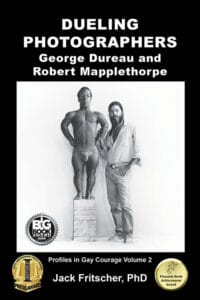

WINNER! 2025 Independent Press Award – LGBT Non-Fiction
SILVER: 2025 NYC Big Book Award – LGBT Non-Fiction
WINNER 2025 Pinnacle Books Achievement Award
This George Dureau video interview, recorded by Jack Fritscher on the second-floor porch balcony of Dureau’s home overlooking the French Quarter on Monday, April 8, 1991, is Take 3, Part 2, of Dueling Photographers: George Dureau and Robert Mapplethorpe. In the second half of the session, the New Orleans painter and photographer discusses his influence on Robert Mapplethorpe, why he photographs men with missing limbs, and art and politics in the 1990s, then sums up his career with advice to young artists. The interview begins in Part 1.
Read Part 1
Monday, April 8, 1991
6 PM-8:30 PM
EXT. NEW ORLEANS. TWILIGHT.
THE SECOND-FLOOR PORCH BALCONY
OF GEORGE DUREAU.
OVERLOOKING THE FRENCH QUARTER
Dureau’s Influence on Mapplethorpe
It tremendously influenced Mapplethorpe. He was absolutely shocked by them, because until that time [we first met in person] in 1979, he had never seen compositions that he didn’t understand, I think, at first. But it all came out of art history. It didn’t come out of photography history. It came out of painting and drawing history, my photographs. Because that’s what I brought to photography. I brought the knowledge of postures, of poses, of things that had happened in the Renaissance, etc.
Not that I’m such a careful student of art history. I’m not, but I am an observer of art history. So I brought to photography all these tried-and-true ideas of presentation of the person, and it had nothing at all to do with what the camera does well or what the camera does other than what I wanted it to do. Nothing to do with the various things the camera can do. It had only to do with how, if you want to tell about a person, you want them to come across, how to direct them, how do you frame the thing, how do you work out the negative and positive shapes so that positive shape looms at you, but the negative shape supports it.
Those are the things I had been doing in my paintings of heads and torsos all along. I didn’t do anything different in my photographs than I had been doing for twenty years in my paintings. My paintings were buttery, close up, strong, carved-out portraits with very strong contours. Sometimes naked, sometimes just heads. The photographs were exactly that type of thing.
Jack Fritscher: That must have startled Robert when he first saw your work.
George Dureau: He always had scenarios, nasty scenarios, in mind. What kind of scenarios, what kind of hanky-pank will catch people’s attention? As far as I know, up to that time, there was always some kind of activity that was unnerving or shocking or exciting in his pictures. There was sort of a “things-happening-in-a-room-sort-of-look” in the photographs that he showed me. We swapped some photographs then. In the ones I picked out, I was looking for ones more like mine — filled with space, contours important, shapes important, and them some presence in the person.
His photographs before that were more like slices out of an intimate movie. The ones of him with the whip [up his bum, Self Portrait with Whip, 1978], boys in the room doing different [S&M fetish] activities, and what not. His were more like figures in a space, and mine were more like the big figure occupying the space totally and just leaving small negative spaces parked around the thing.
He loved the ones that were close-ups of deformed arms, the boy looking at you. Things like that had strong lighting, but the bodies were always sculptural and immediate. The immediacy in my pictures was also kind of sociological, appealing, and solicitous. You were brought into the person’s plight or his beauty or whatever. It was solicitous in the sense that I was saying that this person is wonderful and you’re going to want to know about him, or this person is terrible and you’re going to want to know about him.
That immediacy for him was a way of scaring people even more. So the early ones — in which I may have had some influence — would have been those in which he had his same scary subject matter, and he made it more scary by moving them in tighter and composing more tightly as I did.
Judging by the pictures that he bought from me at first, that’s what he did. That is to say he bought my pictures which I immediately saw reflected [in his photographs shot immediately after]. Heads real close and leaning over, but the eyes still looking at you.
That [eye contact] was a funny thing. I never would have thought that art photography, even as I was turning to it, didn’t do the same wonderful thing that candid photography does or painting did. That is, capture the person by looking straight into their face, right?
But art photography before that always seemed to be someone staring off somewhere into space being instructed not to look at the camera. The only instructions I ever gave were: “Stay looking at the camera” or “Look into the camera.” That difference was very strange because my pictures had maybe the arty finish and the modeling, the shape and form, made from another kind of art, but they had the straight-on look of a [personal] photograph of your little boy or your wife. So they had that funny [hybrid] look about them.
Now the first ones [of my photographs] were mistakenly said to look like Diane Arbus when what they were was “anti-Arbus.” They were so close-up, because all I had was a short lens, and I didn’t know that. They were very close-up. So the very first pictures were thought to be scary like Diane Arbus. And since a lot of my friends were dwarfs or people with missing limbs, people who were handicapped in some way, because I’ve always known a lot of them, it was believed that my pictures were like hers in that way. It was absolutely opposite because mine are so solicitous and the people are presented always [kindly]. You want to know more about this person whereas she did the “Bang! Shoot One! Kill Him and Get Him out of Here” approach to people. Diane Arbus, um, Diane obviously, really and truly thought all those people she photographed were just freaks. I mean she really and truly believed that. Just freaks. Don’t blame me. Susan Sontag said that to me. She said, “Arbus is a middle-class New York woman and those are freaks to her.”
There’s a real “Walt Whitman” air, I guess, to my photographs. [Whitman’s famous inclusive line in Leaves of Grass is: “I am large, I contain multitudes.”] I now allow myself the luxury of composing more, and making more prettified pictures, without the portraiture being so strong, and that may be Mapplethorpe’s influence back on me, doing that sort of thing.
But I always did that in my paintings anyway. On the other hand, there are some people who are so wonderful to look at straight in the face, I find that I can’t turn them away. There was a big difference in that Robert’s orientation to people was so much, I’m afraid, shallower than mine. He had much less patience with people whereas the people you see in my photographs, you’ll see them again ten years later. I have photographs of people, for instance, of Troy, over twenty years. You might see them again just six months later when you might see them in a different kind of way. But I don’t think Robert had the patience to put up with people after he shot them dead once. It’s very funny, isn’t it, that you “shoot” people and you “shoot” pictures.
Jack Fritscher: And presidents.
George Dureau: The camera can be very mean, very disturbing, very dispassionate, really hateful, and it can be adoring.
Jack Fritscher: Don’t you think that perhaps your romantic approach as opposed to his slick fashion photography…
George Dureau: What we now call his “slick fashion photography,” I’m not so sure that he didn’t develop that off me and Berenice Abbott and other people like that, and [Irving] Penn and [Richard] Avedon; but it wasn’t there, I don’t think, when I first met him in 1978 or 1979.
My photographs were never slick and fashionable, but they have a rich velvety air and careful composition. Sometimes they might have a false candor. A person might be coming at you like this.
George crosses his arms with left palm on right shoulder, and right palm on left, and leans forward on his elbows, ready for his close-up, tight into the video camera.
George Dureau: Am I too close? [Laughs] I had been going through two rolls trying to get the arms into the right position for that, right? So there was a mock candor to mine, as there might be in a Manet portrait. You might say, “Oh, the candor in a Manet portrait!” Well, that candor took Manet six months or six years to get in that picture. So it ain’t so goddamn candid. Well, that’s how my candor is too. Sometimes you work at it, you build it, you get it there, and then you blow it all in an act of love of getting the eyes right.
Maybe it took you six months to get to that point. In my photographs, sometimes I keep moving the person [the protagonist in his photo narrative], nudging him into position. [Leaning into the video camera] Am I too close? [Laughs] And then trying to get the focus right. “Put your head a little bit higher, a little higher, a little lower.”
I would take two, three, or four rolls of the very same pose because I knew the pose was right. I just had to get it right. But Robert was doing more scenarios [that were] kind of wacky. [It was as if Robert were saying,] “Didn’t I surprise you with this?” Those weren’t quite up to slick photography. Not that it should have been; but I think his slickness developed after taking the classicism from me and from some other people like me.
Hmm. Are there any other modern photographers, contemporaries that he seems to have shared something with? Because we know how influenced he was. [There are] the pictures of his that are definitely reminiscent of George Platt Lynes, and, certain muscle photographs that we all grew up on twenty-five years ago in cheap magazines [that he found in adult bookstores on 42nd Street]. But he’s taken all of those things and given them a certain slick beauty.
Jack Fritscher: He liked 1950s physique photographs [in pocket magazines like Tomorrow’s Man].
George Dureau: But I don’t know any others [influences]. I’m trying to think. Are there any contemporaries of his? He knew, liked, and admired my photographs, right? Were there any others that were like that to him?
What he did with the others, he would take muscle photographs that would appear in leather magazines and he would improve them
To build his first collages at Pratt, Robert cut photos out of magazines featuring muscled leatherboys sold “for artists who can’t afford models” shot by gay Chicago photographer Chuck Renslow at Kris Studio and published his pocket magazine, Mars and Triumph, both founded 1962. Influenced by Renslow, he was well steeped in leather when I assigned him to shoot the cover of the leather magazine Drummer in 1977.
George Dureau: He would take the subject matter, just the funny wacky, sleazy style, and he would glorify it. What’s funny is that in mine he would take [my], what I would have called “moral nudes,” what Kenneth Clark calls “moral nudes,” meaning nudes that are non-sexual. Those moral nudes talk about values — like a chorus, like Greek things do, like true classical art does.
He took those and made them more, I guess you could say, contemporary, but that’s not so. By making them more sleazy or more common somehow. I would have details in mine that would maybe say who the person was, or where they were from. He would put details in perhaps that would say what act they were going to get engaged in or something. He put in cruel sorts of details that would speak sort of using that person. And mine would be details that would say where that person is from and what he’s like: maybe a tattoo would say that, or some piece of luggage under an arm — but [my photographs are] not what I was going to do with him, or what you [the viewer] might do with him.
He made pictures that appealed to the rich, conservative, or fascist gay audience that he was appealing to. He would put [cast] anybody in his pictures if they looked like somebody you could buy, or use, or handle. And mine would not look like people you could buy, or use, or handle.
I know his friend Sam Wagstaff was offended by the fact that I liked my models so much and they were permanent underclass kind of people. He thought that was not right for Robert to be interested in; but it was alright for Robert to be interested in these people if they looked like they could be used by the people who would buy the pictures.
And knowing who buys the pictures, that’s what worked. They were publicized. His whole career has been further publicized and bought by people who are usually well heeled, or look like they are, or wish to be well heeled. People who can buy and sell the stuff that’s in those pictures.
Whereas there is always that look of “other” human beings that you have to tolerate in my pictures. I’m shamelessly humanist — and it’s all over the pictures. It makes mine a lot less saleable and sometimes a little less bearable because my pictures flush you into a corner sometimes by being full of problems, social problems and political problems and such.
Jack Fritscher: Robert formalized those people, stylized them into something beyond themselves.
George Dureau: I think he bought people more than I did. I pay people a certain amount of money to pose for me, but I don’t pay them enough so that [unlike Robert who paid too much] I’ll never have to see them again. We discussed prices a lot; and there was the major difference that in New York people [models] know who you are and they know what they can get out of you. And they say, “$500.” In New Orleans, somebody would say, [he smiles lovingly]: “Gee, ah’d like to be in yo pictures, oh yeah.” So then I’d pay them for taking the picture, but I’d see them the next day and the next year and four years after that when their momma would tell them, “I have to pay the electric bill.”
I paid less for the modeling fee; but I would pay more later in friendship or closeness or just our village co-existence. But Robert felt very threatened by the people that he photographed. He wanted them never to come back again. He would get furious. He would give them a signed photograph and they were supposed to go off and sell it, but [instead] they would say, “Oh, it rained, or it [the photo] went down the toilet,” or something, and they would come back for another one and he was furious that they would keep bothering him because he just wanted them to go away.
Jack Fritscher: He wanted them, like his tricks, for the moment.
George Dureau: Do you know? I have a friend in New York who once talked about an early Louis Malle picture, Lucien Lacombe, I think. Anyway, the actor had been discovered — the star of that movie was a non-professional; he was a wonderful-looking peasant boy. Louis Malle discovered him. The boy got lots of money, got a convertible sports car, raced it down the street, went off the road, and was killed. And my friend said, “Oh, what a wonderful way! He [Malle] didn’t have to put up with him making more movies.” And it’s true. I think Robert felt that way [wishing]: “I want them just to exist in this picture and don’t want to see them again.”
There were very few of his models he’d would get a crush on so much that he wanted to carry on with them. There were some, of course. Unfortunately, I’m capable of carrying on affairs with everybody on earth at the same time. Not successfully, but energetically.
I know the sons of people that I’ve photographed back in the 1970s. I’ve drawn people in the 1960s that I now draw the children of. It’s a very strange thing. I’m not saying it’s the only way to do it, but once you’re doing that, especially if you’re a sort of “classic art creature” which I am. I live my life and it’s reflected in my art. My art tells what I’ve learned or failed to learn. It’s very hard to give that up and say, “Oh, I’ll just go someplace where I don’t know the people and I’ll see some different kinds of faces.”
Jack Fritscher: He liked shooting new faces of leathermen in San Francisco.
George Dureau: I think New Orleans is about the size that Paris was when Paris was great, yeah, I mean for creating art, for knowing your subject matter, for knowing the people you’re dealing with, for reusing them and them being there when you need them for reconsidering things, for redrawing a picture and throwing it away and doing it another way. The people are there the way you know the grocer you’ve known for thirty years.
I don’t know if it’s insecurity on my part, but I really like the fathers of, the brothers of, the children of, the wives of [my models] to think of me as that nice artist who drew their daddy.
They don’t have to like all the pictures, but they come in, sometimes, people who I’ve photographed or drawn, they’ll come in and say, “Man, you see me better than I do.” Or “You just know how that kinda dude thinks.”
To me it is somehow more comforting than having a critic say, “He did that well,” when I know the critic doesn’t know what I did well because he probably doesn’t have the experience I have.
My pictures are frequently experienced and shared with the models. Only I know a lot about what they are and it goes into the pictures and only they can verify it. Not that I spend all my time getting it verified, but it’s comforting that things regularly get verified. You can move along knowing that you’ve done a human activity which is attractive to yourself, that you’re proud of.
Jack Fritscher: Some critics struggle to fit “what’s new” into the traditional principles they studied years before in school.
George Dureau: We have an energetic and very serious — you met him the other night — critic here in town. But I don’t really expect him to know all of what I’m doing. He’s the one [local] critic and it’s kind of hard for him to like all the things I do. It’s very hard for a critic in a place like New Orleans who has been looking at the same artist for fifteen years to find something new to say. So all of a sudden critics get negative. Simply because they got tired of being positive. They can’t keep saying the same thing year after year. They wish you would change, but I’m not going to. I want to improve, but I don’t hope to change.
Jack Fritscher: A new set of critics is needed?
George Dureau: Change the critics, but keep the artists. That would be good. You could shift critics around from town to town.
Jack Fritscher: Many artists in many towns would be happy if that were to happen.
George Dureau: I really haven’t been damned much. I’ve been praised a lot. I think my work is a great deal more sound than people know. We live in this age of novelty because of galleries and sales. Galleries cannot keep paying the rent if they don’t have novelty.
It’s the same as in the fashion industry. I once was a “window dresser” in the fashion industry and it’s exactly the same thing. You have to convince window shoppers that this new thing is better than last year’s. So you have to damn last year’s wonders in order to convince people that they’re going to want this year’s horrors. I’m not going to change for those reasons. I doubt that I’d do the right thing for me and my talent and I just have to pursue it and improve it.
Photographing Men with Missing Limbs
Jack Fritscher: What drove you initially to physical disability, to men with missing limbs?
George Dureau: Charcoal! [Laughter]. Since childhood I’ve been more than fascinated, just drawn to people who are handicapped, but particularly to people who are triumphant though being handicapped. I’ve always loved tough dwarfs. Always. I can remember “Long John Silver” kind of creatures. The buoyant, tough, or wild drunk on one leg. I’ve always thought that the pirate-y kind of person was always the most fascinating to me. I’ve explained it to myself, but it’s too hard to explain in public. But I’ve always been attracted to little people who act strong and big. It’s just super triumphs that I like: heroes!
I guess that’s one of the things that made people like Sam Wagstaff un-attracted to my work. He kept saying how wonderful it was, but he wasn’t about to buy any. I saw him a great deal. He would pick out the things that were all right for Robert to be influenced by, but…
Jack Fritscher: For Robert to build on.
George Dureau: Right. Exactly. Because Robert loved my stuff, and had already bought a number of things. Wagstaff picked out some things from one of my shows, but Robert just absorbed them. Wagstaff didn’t buy them. Robert bought them, a lot of my stuff. So he had about sixteen pictures [before we met] because that’s what he bought from me, but it turns out [George alleged] that the gallery we’re both in, in New York, the Robert Samuel Gallery [in which, Frances Terpak and Michelle Brunnick reveal in their 2016 book Robert Mapplethorpe: The Archive, Mapplethorpe was an “active business partner”] must have paid off some debt to him or something with a bunch of my photographs because a whole lot of photographs that I never sold have gone through the auction houses and some of them have ended up on the West Coast. There’s a gallery out there that Robert showed with, a big, very flashy gallery that had, apparently, a bunch of my photographs that were 8x10s that I never had sold. They were just proofs that the gallery in New York had.
I think something inexplicable happened in the 70s and early 80s and a lot of photographers’ work got picked up by somebody mixed up in a, I don’t know, some kind of shady deal, and then the pictures got spread out again. People were paid off. A lot of people got my work that they did not buy, as such, because they were kind of like reimbursed for investment in the gallery, or something like that. It’s hard to make galleries work what with high overhead, and the gallery directors sometimes just turn bad. Although they may not have started off bad, they turn bad thinking that they’re going to make it work for all of you, you know. “Oh, it’s all going to be all right, darling. Just don’t worry about it. We’re going to pay you back eventually.” And it goes down, down, down, and nobody gets paid for anything. But I didn’t pursue that [West Coast] gallery. Mapplethorpe did pursue it, but I didn’t. I wasn’t going to be retaliatory about it.
Jack Fritscher: Where do you think you’re going to go in the 1990s with your painting and photography? A balance between the two, or do you have a feel for…
George Dureau: I’ll always do more paintings and drawings. I think. In terms of time, still photography takes so much less. Say, if I was doing two sessions a week, three or four hours each, I was just burnt out from doing it. First of all, because I don’t make up a lot of stories that I want to do in photographs. I have a lot of stories already that I want to do in paintings — and photographs are almost always hinged on the presence of some person.
Even in these, where I’ve messed around with the people and used them in a sort of repertory way, turned them around and photographed their asses instead of their faces, even in those it’s the person because [I ask myself] will Glen [Thompson] want to do that? Does he mind? Does he mind being used this [way] one time, knowing that the next time I’ll do a wonderful job of looking into his eyes?
But anyway, it just exhausts me totally to do more than two afternoons of photography because we really work hard and intensely at it.
Jack Fritscher: How’s your painting as far as timing goes? Do you find that you go on great binges of painting and then there’s…
George Dureau: Sometimes I’ll paint through a long time. But I paint in stops and starts. I’m painting a lot right now, and I’ll get out of it for a while, and do photographs and drawings. [George effectively stopped shooting photographs in 1988.] Part of it is making a living.
I make the most out of small paintings and big drawings. But I just love drawing and I do it every day. So it is the link. Line and form as they are in my drawings are always going to hold the whip over everything else.
How I draw in the morning is going to influence how I pose someone in the afternoon. The contour from the head down to the leg as done in the drawing is probably going to come up in the pose somewhere, in my photographs, or in my paintings. Because drawing to me is always the backbone of what my head is doing.
Jack Fritscher: Your home is wonderful. How long have you lived here?
George Dureau: I’ve been here for about five-and-a-half years, almost six. Before that I lived in a house that was gigantic, but the rooms weren’t as big as this. This [house and studio] is what we affectionately call “Queen Anne front” and “Mary Ann behind.” It looks like a wonderful typical French Quarter house although it has a bigger balcony than all the others from the front. But when you go inside, it is relieved in a sort of Soho loft sort of way by the fact that it has always been a warehouse. It was gutted about one hundred years ago. I never would have gutted a house like this. They’re too fragile, these little brick houses. I never would have dared to take out five or six walls, but since they did it and its still standing, I went ahead and kept it that way.
So I have two huge rooms with smaller rooms off them, and they function wonderfully because I learned in the other house that you need “back away” space.
In photographs, you have to back the stuff away from you.
In painting, you have to move the paintings away if you want to do another painting. You want to move them away if you want to work on something else. We didn’t put walls in. We just left it. So it is a kind of family house with a huge porch wrapped around it and generous windows and comfortable furniture. But at the same time it has the flexibility of a little factory. So I can move my big bed and my little bed and my sofas to another spot if I want to as I’m going to do when we’ve changed that stair [stairway entrance]. We’re going to change the orientation of the front room.
Jack Fritscher: You’ve lived in New Orleans all your life and you don’t travel.
George Dureau: I lived in New York once for about nine months [in the 1960s]. I liked it while I was there. But as soon as I got home I thought, “Oh, thank God, I’m home.” I’m not aggressive. I might be dominating, but I want to be told that I’m the one that dominates. I don’t like to knock on doors and have to go tell someone that they’re supposed to love my painting. I don’t want to do any of those things.
If somebody invites me to go somewhere and do it, I’ll do it. But I am not a traveling salesman. I cannot knock on the door.
I guess I’m kind of grand in that I expect to have a place in society that’s comfortable. I expect to have a certain amount of respect, and I expect to work very, very, very hard all the time and not to have travel time, to be working all the time. So although I expect position and respect in my community, I work so hard for it, I don’t feel bad about it. As Michelangelo said, “If they knew how hard I had to work to achieve my mastery, they wouldn’t think it was so good.”
Art, Politics and the 1990s
Jack Fritscher: Since we’re in the second year of the 1990s, the last decade of the century…
George Dureau: Yes, I’m the fin de siecle artist. Fin de siecle, here I am!
Jack Fritscher: Can we tie this up and can you project for me where you find art, painting, photography, you, what’s expected of you. You’ve just joined this very political New Orleans exhibit in response to the Gulf War, a wonderful piece.
George Dureau: I like to do things political, and I’m glad that I’m just as happy to do that now as I was in the 1960s. When I do something political, it usually has a broad universal kind of aspect to it. I’m not very particular about things. I did all kinds of “integrated” pictures all through the 1960s and I also did pictures, if you wished to see them as “homosexual,” yes, they were homosexual in that there was only one sex in the picture sometimes.
But I also did pictures that had women in them, and I also did pictures with just women in them.
But I like to make statements that I guess are political or sociological. Although most of my pictures in the house are not political, I’m not apolitical. There’s always a certain politics to them, my own human politics, but I was once at a lecture and some critics and some art historians were talking, and my friend Edward Lucie-Smith asked them, “Now what is your favorite painting in the whole world?”
They went around this group and each came up with a painting that he thought the most wonderful painting ever painted.
And I said, from the audience, “May I have one question? Well, one statement? I think this is really strange because I never noticed it before, but every one of the paintings that you mentioned was a political painting, and we always think, ‘Oh, painting is trivialized by bringing politics into it.’” They were Guernica, Liberty Leading the People, Death of Marat.
I mean, every one of the pictures, I can’t think of them all, there were eight pictures, and they were all political pictures from their time. In their day, they were all some sort of a placard or banner.
All through the time I was in school in the 1940s and 1950s, we thought, “Political painting is trashy.” You’re supposed to be above that [because] that ruins you. But in truth it seems to raise the pictures above the ordinary. So I hope I paint a good political picture here and there.
Jack Fritscher: I think you do because of the consciousness raising you are bringing to the 1990s. Taking people who are physically disadvantaged and in a sense glamorizing them, helping them transcend stereotypes.
George Dureau: That’s always going to be in my pictures. That’s my gut politics. It’s always going to guide what I paint. But it’s nice too, and it gives you a nice young feeling to politically organize your thoughts behind a “Big Complaint.” Once in a while a “Big Complaint.”
Jack Fritscher: What would you see as the “Big Complaint” on the horizon as the century clanks to an end?
George Dureau: Unfortunately, I’m that artist who is content to paint the same pictures over and over, but better, he hopes. I’m sure that complaining against military police power, a police state, and police control in shaping of the world, is going to be something to continue to complain about and continue to chip away at over the next few years.
Because I have the feeling that we are getting into [government] controlling the way other countries do business. We are not just using “military might” to keep a peaceful order.
I’m afraid that we’re on a tear now, that we’ve discovered where we’ve failed economically, and where we’ve failed politically and morally. We [think we] can clean all that [our national moral failure] up by using our guns and make “ourselves” like “ourselves.” We really look like we’re on that path.
Somebody said recently, “Oh, we Americans find it very easy somehow to turn success into moral right.” Because we were successful in the Gulf War, we’re bound to tell ourselves that “You see! We were morally correct.’” And unfortunately, I think we’re going to do a lot of that [moralizing war] thing soon.
But my mainstay always will be painting pictures of particular people, of particular sets of people, or particular things that happen to people. bringing them to the fore so that they can be enjoyed and understood and shared.
Jack Fritscher: So you let the world go by while you continue with your art.
George Dureau: Well, presenting what is good about human beings is my particular talent. I know it is. It’s why I sell. And I sell a lot! I don’t sell pictures at New York prices, but I sell them at the top of New Orleans prices. The people who buy my pictures buy them in spite of themselves, half the time. That really makes you feel good because you know they bought it because they really had to have one of those. Even though it was going to be a bit unpleasant and they would have trouble explaining it to their teenage daughter or their own mother. They still had to buy the picture. And people would say, “I don’t know why she bought that picture, but of course he’s a wonderful artist; but I don’t know why he paints those pictures either.”
Jack Fritscher: Wasn’t there a young couple who married, and all they had was a kitchen table, and a couple of chairs — and a Dureau?
George Dureau: Yes. That’s one of the wonderful things. Wonderful collectors. I guess that’s one of the things you give up when you enter a vicious — it’s hard to think of “New York” as the mainstream, [more like] the “main eddy.” I always think, I’m the mainstream in New Orleans and they’re a serious eddy down the road over there.
One of the things you hate to give up [if you sell at New York prices] is selling pictures [cheaper] at not too terrible a price to wonderful people who share an intelligence with you, who share your beliefs or your humanity, people who are not necessarily very rich and people who don’t necessarily follow art trends. But you say something in your painting that may be similar to what they think in their philosophy, or in their medical practice, or what they may be interested in, their poetry or story writing. I really like appealing to intellectuals other than art groups because you never really know why people who are art junkies are buying your pictures. Sometimes you go to their house and there’s the one Dureau and the one so-and-so, and the one so-and-so, and the one so-and-so.
Jack Fritscher: The baseball collection card approach.
George Dureau: Yes. The full set. But I like my customers a lot. That really makes me happy.
Jack Fritscher: You mentioned you like your clients to come to your studio to look through your work because you get a chance to…
George Dureau: It’s exhausting sometimes. It draws you away from your work and keeps you from doing things. But, on the other hand, I’ve met some of my very best friends by being patient and letting people visit me because they wanted to see my studio and see what it is I’m up to, to see why they like my photographs or my paintings.
It is kind of a problem to have someone want to come and see your work, and want to meet the people that you draw and paint. I find it very hard to not say, “Thank you. I’m glad you like me,” when somebody really is devoted to my art.
Jack Fritscher: You also get a chance to watch the psychology at work as they make a decision between painting A and painting B.
George Dureau: Yes, and it’s amazing. Not that one should paint according to that, but you learn some really interesting things about your own work when you do this. Some people pick tougher [photographs], and sometimes people make rougher and braver choices than I would make.
It’s the reverse of what most people would think. The people who swim the moat, so to speak, the people who pick up the telephone and call you and say, “I didn’t know I could get you on the phone. I would love to see your work, but I don’t want to disturb you.”
If you have them over, sometimes it is very strange. You can find out, in some sense, that they have better taste than I have. I might average out or normalize my work in my head. I’ll be thinking that they’re going to buy down-the-middle, something that is not too wild and disturbing and something that is not too sweet and gentle. Not so. They might fool me completely. They might like the unfinished drawing that is really tough and scary and I never would have shown it in a gallery.
Frequently, pictures that are bought from my home are pictures that never would have made it to the gallery. Not that my gallery doesn’t have good taste, because he certainly does, but in talking with him like a marriage where we talk things out, we might drop a photo. And it might not be his fault. It’s me thinking it’s not slick enough or pretty enough or frameable enough. When people come to my house, they sometimes buy something that is a lot closer to my roots, a lot closer to my bloodstream than I would have shown in a gallery.
Jack Fritscher: What’s your lifetime estimate of how many paintings and photographs you’ve done?
George Dureau: I’ve done thousands and thousands of drawings. I’ve done little thumbnail drawings. I do drawings like storyboards for my photographs now. I didn’t do that at first, but if I know I’m photographing two guys and doing them together, which isn’t too frequent, I’ll do a bunch of drawings, just so I don’t forget what I was thinking about when we get into the heat and craziness of doing the shoot.
Some of those drawings I love, and I’ll do little sketches like that. Regularly I do charcoal on rag paper. Every day I keep a couple of easels about and I draw faces, poses of several graceful women’s bodies together. I’ll do some fornication scene. I have all these things going all the time, and I begin an immense number of things and then finish them slowly over a period of time when I get an another idea of what to do next.
I work very fast so there are literally thousands of sketches lying around. And the photographs? I have them neatly filed away because you have to do that. It’s the only way. You have to have negatives put away neatly and archivally. I guess there are hundreds of thousands. I don’t know. If someone is worth shooting, I will do ten rolls of twelve. So there are 100 to 150 sometimes of very similar exposures of anybody I find worth photographing.
Jack Fritscher: We mentioned movies earlier, and since you are including storyboarding as a procedure, and since you mentioned video as an interest, might you take up shooting moving pictures as the century draws to a close? Perhaps a new dimension of Dureau’s photography?
George Dureau: Storyboarding is just visual note making. I’m what they call them a natural-born adult note-maker. If I’m going to call somebody, I don’t want to waste their time. So I make a list of things I want to talk about. That’s hysterically boring, but that’s what I do. And that’s what you do in drawing too. You make some little sketches of what you’re going to do. I draw them real fast. It’s very easy for me to draw quickly to a certain satisfaction. Finishing something to make it elegant, poetic, and wonderful to look at, that’s something else. But I draw well and fast. So why not draw all the time? Drawing is something you get nothing but better at the more you do it. Better!
A Career Summary and Advice to Young Artists
Jack Fritscher: Can you summarize your own career at this point?
George Dureau: I may have said it in that [last] line. It’s funny. I would have thought when I was in college, and right after, that my art was going to be this exquisite, somewhat austere, magnificent stuff out there, and that’s happened, although it’s big and Baroque and operatic, and it is to me exactly like my life. It’s an extension of my life!
I don’t know if anyone told me that’s what I was supposed to do: live a life and reflect it in my art. But I think the paintings are a lot like I live. Although I live a conservative life, in its safety, I don’t do drugs and lie around in the street, which I may have come close to in the 1960s, but I’m fairly self-preserving about how I live and what trouble I don’t get into.
But there is a lot of warmth and passion, a lot of dinners and candles in my life.
I think it is in the art. When I get to the end of this century and look at my work, I will always know exactly what was going on when I look at a picture. It’s not like looking at some abstraction. I mean I look at my pictures and I know all the people I’ve painted and I say, “Oh, that’s Troy,” but I had to use so-and-so’s hand. Oh, wait, that’s my hand. I know that hand. I painted my own hand in there. So everything in my art is something chopped out of my life and put into paintings. And some things that I put into my paintings, I then go ahead and live them out. Some stuff starts in my drawings, but then I make them come true.
I did drawings in the 1950s that I then made come true in the 1960s. And things I drew in the 1960s I know I made come true in the 1970s. That’s a funny idea, but I know it’s true. I guess it’s the same brain, both sides of the brain are always thinking all the time both in the way I live my life and the way I do my art.
Jack Fritscher: So to young artists you might say what?
George Dureau: I don’t know how they do it today. Life looks so dangerous. I’m glad I lived earlier. I don’t know how I made it through the 1940s and 1950s. I really miss the 1960s though I don’t go around acting like a 60s person, I suppose. But I really miss all the commitment and all the nerve endings hanging out in the 1960s.
And that’s why I say it’s fun, more than fun — great! — to once in awhile get really mad at something and put all your talents together and do a painting. I do it in drawings too, of things that I’m really mad at or really concerned about. I think it’s wonderful to work with a great deal of concern.
Jack Fritscher: Are you frustrated by concerns sometimes? [Referencing a rumor in which Dureau vented discontent in front of witensses] Do you throw pots? Pre-Columbian pots?
George Dureau: No. If I get angry nowadays, it’s because I’m frustrated about not having enough time in a day to get done all the things I want to. Too many careers going on, I think sometimes. And that gets me mad. I used to get drunk and frustrated back in the 1960s, but I don’t do that anymore. I’m very controlled about eating and drinking.
Jack Fritscher: How old are you now? I’m fifty-one.
George Dureau: I’m sixty. I’ll be sixty-one in December
Jack Fritscher: Do you think you’re going backwards in time in terms of your youthful energy? Your energy level seems incredibly high.
George Dureau: I’m getting a lot cuter.
Jack Fritscher: That helps.
George Dureau: I’m in good shape, very healthy. It takes a certain amount of taking care of oneself.
Jack Fritscher: So that “self-destructive artist syndrome” is not part of your personality?
George Dureau: I outlived that. It’s funny. I turned my Scots/Welsh/French and German [genes] in the right direction. I started out being drunk all the time. I just turned it around and decided to get mean in my own behalf. I’m very well controlled. I just wish the rest of the world weren’t so boring.
Jack Fritscher: It’s the decade. It’s the end of the century.
George Dureau: Don’t you think that we’ve said everything?
Jack Fritscher: If you think so, I think so.
George Dureau: Thank you. It was wonderful.
Jack Fritscher: Thank you. It was wonderful.