Jack Fritscher’s American Men
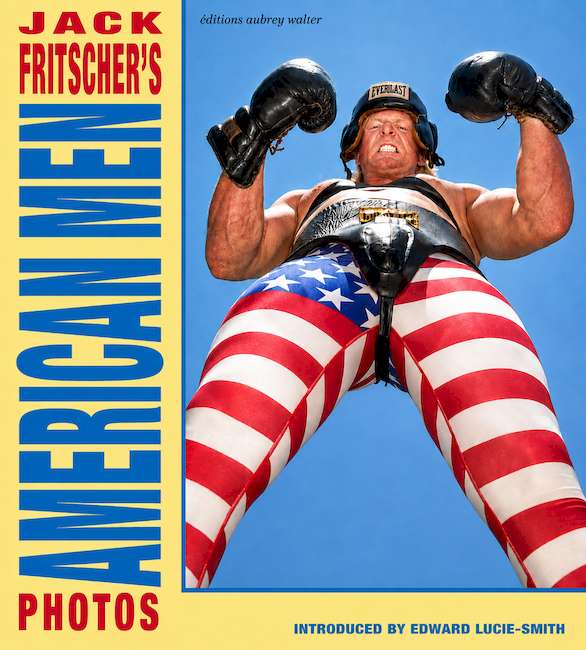
A British Coffee-Table Photobook of American Images
60 Photographs
Shot During 25 Years
Introduction by Edward Lucie-Smith
Photographer’s Foreword
“Water from the Moon”
(Ancient Japanese Saying Defining Something One Can Never Have)
On the title page of his dog-eared Billy Budd, Ryan wrote, in the most legible scribble of all his random notes, what must have come to him, suddenly, as a simple, illuminating, uninterrupted, crystal line vision of sexual elegance.
That first night when I first saw Kick, I recognized one of life’s long shots at the Perfect Affirmation.
He was a man.
He had a man’s strength and fragility, a man’s grace and intensity, a man’s joy, and a man’s passion. He seemed my last chance to celebrate the changes in me as growth. He was so fully a man, he was an Angel of Light.
To him I could say nothing but Yes.
One thing, you see, I know for sure; Nature very rarely puts it all together: looks, bearing, voice, appeal, smile, intelligence, artfulness, accomplishment, strength, kindness. That’s what I looked for all my life: the chance to say Yes to a man like that.
I look in men for nothing more than that affirmative something that grabs you and won’t let you look away. Maintaining my full self, to have some plenty to offer back in balance, I’ve looked for some man who fills in the appropriate existential blanks, for some man to be the way a man is supposed to be, for some man to keep on keeping on with, in all the evolving variations of friendship and fraternity, beyond the first night’s encounter.
I’ve looked for that to happen: to be able to say Yes inside myself when a good, clean glow of absolute trust settles over the world.
Honest manliness is never half-revealed. When it’s there, it’s all right there in front of you. The hardest thing to be in the world today is a man.
Jack Fritscher, in Jack Fritscher’s American Men, quoted from his novel Some Dance to Remember
Editor’s Note: The Black & White cover of Jack Fritscher’s American Men appeared in color on the cover of Powerplay magazine #10, May 1996, Joseph Bean, editor.
To sample Jack Fritscher’s written essay on photography, see his article “When Sex Meets Violence: The 1982 Leathersex Nude Photographs of Jim Wygler.” Powerplay #10, May 1996. Also see the nonfiction book written by Jack Fritscher in 1994 titled Mapplethorpe: Assault with a Deadly Camera
Reviews: Jack Fritscher’s American Men
LARRY TOWNSEND NEWSLETTER
Summer 1995
United States
by Larry Townsend
The Jack Fritscher book American Men is a collection of terrific photos by one of our favorite authors.
©Larry Townsend
CHECKMATE
July 1996
United States
by Victor Terry
Jack Fritscher’s American Men, Editions Aubrey Walter, 1995, $29.95. Non-Fiction. Photos from the 70s through the 90s by Jack Fritscher of men in underwear, leather, rubber, jocks, boots, and nothing at all; of bodybuilders, cowboys, ranchers, cops, street trash, daddies and boys; of bears and smooth torsos. None of these men are twinkies, and many have appeared in Fritscher’s Palm Drive Video tapes. Most of these men personify aspects of raw raunchy sexuality. The best known model is Donny Russo.
Other books reviewed in the same article: Coley Running Wild: Book One: The Blade and the Whip, by John Blackburn; Man Hungry, by Gary Bowen; The Black Book, by Bill Brent; Flashpoint: Gay Male Sexual Writing, editor Michael Bronski; Fully Exposed: The Male Nude in Photography, by Emmanuel Cooper; Pierced Hearts and True Love: A Century of Drawings for Tattoos, editors The Drawing Center and Don Ed Hardy; The First Gay Pope and Other Records, by Lynne Yamaguchi Fletcher; Best Gay Erotica 1996, editor Michael Ford; Penis Size and Enlargement: Facts, Fallacies and Proven Methods, by Gary Griffin.
©Victor Terry
BEAR Magazine #37
April 1996
United States
by Leif Wauters
For years, Jack Fritscher has been documenting homomasculinity on film, processing it, and turning it out to the public as Palm Drive Video. In his new book, Jack Fritscher’s American Men, he has gathered still photos which eroticize this masculinity. The images he has chosen depict men in a stream of consciousness kept private by most men, namely their own sexual attraction to the male icons of our society: cowboys, cops, bodybuilders, and truckers to name a few. Fritscher’s camera brings us into their fantasies; many of them are hot scenes you will long to be a part of.
Eloquently introduced by Edward Lucie-Smith, who came into the eyes of the bear community with his insightful introduction to Chris Nelson’s pics in The Bear Cult, Fritscher’s collection of rock-hard bodies and street-weathered faces somewhat resembles the work of Old Reliable. The difference between the two visions, however, is that Fritscher’s men have strengthened themselves out of a desire to be some-thing better, exemplifying the icons of their upbringing. We are talking about men who, throughout their lives, were aroused by the strong men of their worlds and have developed into powerfully sexual icons themselves, whereas Old Reliable’s young exhibitionists seem merely to be aimless boys from Hollywood’s Sunset Strip.
Fritscher’s attraction to the beauty and form of masculinity draws him to men removed from the softening of the American man. This book places back upon a recently vacated pedestal the physiques of gods and the determination of warriors. Jack Fritscher’s American Men are what most men today fantasize about: hard driving studs who play as hard as they want and are freed by the strength of their character, ready to fuck with you physically and sexually. You may not be ready to come to head-to-head with some of them, but they will work your heads–both of them.
© BEAR Magazine & Leif Wauters
HONCHO, Vol 20 #6
June 1997
United States
No By-Line
In addition to his work in photography, Jack Fritscher has been many things: university professor, magazine editor, video director, poet and writer–he is well known for the memoir of his one-time lover, Mapplethorpe: Assault with a Deadly Camera. In his own photographic explorations, Fritscher’s focus is on what he terms “homomasculinity,” and in his new collection titled Jack Fritscher’s American Men the photographer portrays the kind of male subjects that most attracts him: bodybuilders, bikers, cowboys, cops, men in various kinds of sports gear and uniform.
These mostly full-page, B/W photographs (taken between 1969-95) are the artist’s documentation of the underlying current of sexual competition and violence he perceives between men, something akin to the rituals of sexual display common to adult males of all species. Many of his images are true candid shots, captured in the sort of public arenas that obsess him: bodybuilding, weightlifting, boxing, wrestling. “I dare to stalk public events,” he admits.
Other images portray men who have been–or are–gay icons, often captured at their most overtly sexual, as in the nude series of macho video star Don Russo. It is particularly in these provocative portraits–and the studies of bodybuilders–that Fritscher explores the way men present themselves to the camera with the full knowledge that they are being observed, admired, worshiped. As noted photographer Edward Lucie-Smith observes in his fine introduction:
“[Fritscher] is always aware that the voyeur…fulfills the needs of the one who is observed, that the transaction, far from being one-sided, is fully reciprocal. He feels that many of the photographs taken in these circumstances–those of bodybuilders posing in contests or on the boardwalk at Venice Beach–are just as erotically charged as those which are more overtly sexual. Even more charged, he might claim, because the relationship between the one who views and the one who is viewed is more complex and ambiguous than it is in circumstances where the sexual element is fully spelt out….”
© HONCHO
BEAR Magazine #38
June 1996
No by line
A Bear: knows what he likes and knows where to find it — in the pages of “Jack Fritscher’s American Men.” Believes that masculinity itself is powerfully erotic. Jack Fritscher understands that and captures it in a collection of his black-and-white photography. Printed on a rich, dull-coated paper stock.
Published in 1995, 62 pages.
Published by Editions Aubrey Walter GMP Publishers Ltd. P.O. Box 247 London N6 4BW, England 181-341-7818 VOX 181-341-7467 FAX
This collection world copyright 1995 Editions Aubrey Walter. Individual images world copyright 1995 Jack Fritscher. Introduction world copyright 1995 Edward Lucie-Smith.
ISBN 0-85449 197 X A CIP catalogue record for this book is available from the British Library
Distributed in Europe by Central Books, 99 Wallis Road, London E9 5LN, England 181-986-4854 VOX 181-533-5821 FAX
Distributed in North America by Inbook, Inland Book Company P.O. Box 12026, East Haven, CT 06512, USA 203-467-4257 VOX 203-469-7697 FAX
Distributed in Australia and New Zealand by Bulldog Books P.O. Box 155, Broadway, NSW 2007, Australia 2-699-3507 VOX 2-699-3527 FAX