
A CROSS-WORLDS ANGEL
Camille O’Grady
Art/Life
by Philip Zimmerman
with
Janet Hamill,
Jack Fritscher, PhD
Will Roscoe
Andy Campbell, PhD
and Jim Stewart

Book Review
The Legend of Camille O’Grady
New Limited edition book rediscovers the singer and artist
by Michael Flanagan Thursday, October 1, 2026
“Lou Reed calls her ‘Patti Smith without a social conscience’” – Lynn A Bahlman, Blueboy Dec. 1978
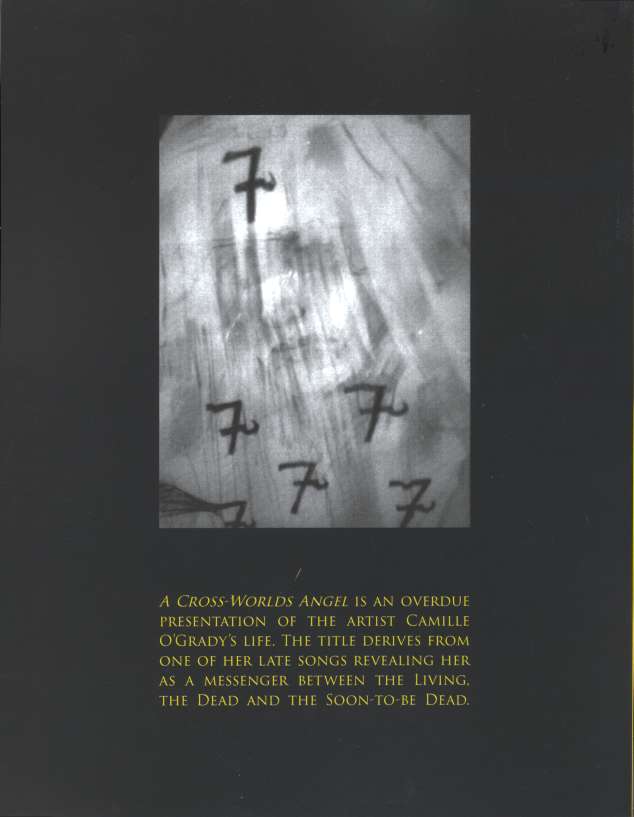
Philip Zimmerman’s biography, “Camille O’Grady Art/Life: A Cross Worlds Angel” is a lush and beautiful tribute to the late singer and artist. It’s also something that I never expected to see. I knew O’Grady, and at the time of her death in 2020, it seemed as if all of her work, both her visual work and her songs, would be lost and remain simply legendary.
When she is remembered now, it’s generally for a few things that grab attention: she was a leather-clad singer who performed at both CBGB and Max’s beginning in the early 1970s. She was one of the few women to ever penetrate the Mineshaft, the BDSM sex club where she ultimately performed on stage.
She attended the Pratt Institute in 1967, where she met Robert Mapplethorpe in her freshman year and began a sexual relationship with him (they would remain friends throughout his life). She entered a Mr. Leather contest at the Spike under her male alter ego Jack Savage and came in third. And she was at Fey-Way Studios in early July 1979 when the studio was invaded and Robert Opel was murdered.
The book does an astounding job of fleshing out the bones of O’Grady’s story. It reproduces her artwork, including pen and ink, graphite drawings and colored pencil, which both illuminate her connection to the early punk ethos and confirm her place in the artistic circles she traveled in.
Myth, legend, art and more
O’Grady’s lyric sheets, both typed and hand-written, are reproduced in the book; as are performance photos of her on stage at CBGB, Max’s, the Mineshaft and opening for Lou Reed at the Bottom Line in 1978. There are many performance flyers as well, including one for O’Grady’s band Leather Secrets opening for the band Television in the ’70s.
Articles from Christopher Street (March 1978), The Advocate (December 1980), and Blueboy (December 1978) are reproduced from the magazines (including photos). These articles are telling, as they cement the notion that O’Grady was happy to be an underground performer in the leather, punk and gay worlds and was not looking for mainstream success. The Advocate article, “The Terminal Fascinations of Camille O’Grady” was written by the late author Mark Thompson. The pull-quote in the Blueboy article by Lynn A Bahlman is:
“No false images of Fred and Ginger dancing off into the golden moonlight; just everyday men with 5’o’clock shadow at high noon sucking cock underground. And Camille’s singing about it—in Gregorian chant.”
The intellectual heart of the book are the essays and interviews which expand on the visual imagery and bring O’Grady’s story back from the land of myth and legend to where we can see her as a vital artist.
The poet Janet Hamill follows her friendship with O’Grady from downtown Manhattan in the ’70s to San Francisco and a reading they did at the Beat Museum in 2016 in her essay “Queen of the Night.”
Author Will Roscoe writes about “Vortex: A Journal of New Vision,” which was published in the early ’80s and features O’Grady. A short excerpt from “Folsom Street Blues” by the late author Jim Stewart recounts an encounter between Stewart, O’Grady, Tom Hinde and a black leather straitjacket. In “Sensory Adjustments to What’s Going On,” art historian and critic Andrew Campbell gives an analysis of O’Grady’s drawings with multicolored “Magic FX” pencils.
Contextualized life
However, it’s Jack Fritscher’s interviews with O’Grady that put the book in its proper context. In the 2014 interview, “New York,” O’Grady talks with Fritscher about art school, Robert Mapplethorpe, Patti Smith, Sam Shepard and performing at CBGB.
In “Truth” they talk about O’Grady’s introduction to the leather scene (she worked at the Ninth Circle, a leather bar in New York City) and how she was initially turned away, and finally admitted to the Mineshaft:
“There’s a silver-haired guy sitting there dressed in leather. He says, ‘I’m sorry.’ He was very nice about it, but he said, ‘I’m really sorry, this is Men Only.’ I happened to be with about six of the hardest guys in the scene at the time. They all just said, ‘If she can’t go, we’re not going in,” and so Wally cried – like he took stock of the situation and decided, well OK.”
In a nod to completeness, Fritscher’s interview with Wally Wallace on the incident is included.
There are two interviews that address both Fey-Wey studio as the first art studio South of Market (conducted with O’Grady and Opel on April 20, 1979), and as the scene of the brutal murder of Robert Opel (conducted with O’Grady on July 14, 2014). Both are fascinating, but the second is crucial to understand the murder and put it in the context of the violence of the ’70s. One thing is abundantly clear from reading the interview. It was not a robbery (which is what the press said). Both Opel and O’Grady had money which they offered the killers. It was refused.
Camille O’Grady was a fascinating person, some would even say she led a charmed life. Philip Zimmerman has done an incredible job of documenting her life. One hopes this book makes it into the collections of major institutions and libraries so that O’Grady’s legacy will live on.
‘Camille O’Grady Art/Life: A Cross Worlds Angel’ by Philip Zimmerman’s — https://www.instagram.com/camille.ogrady/
A record and book release party will be held at Et Al Gallery, 2831a Mission St., Oct. 1 at 5pm. https://etaletc.com/events
In an additional move to cement O’Grady’s legacy, Dark Entries records is releasing a collection of her work, “Terminal Fascination” on Oct. 2, 6pm, 910 Larkin St. https://www.darkentriesrecords.com