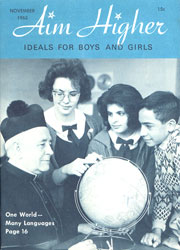
AIM HIGHER: November 1963
Ideals for Boys and Girls
Hurry to Your King
by John J. Fritscher
Jack Fritscher says, “I employed the tools of fiction to re-create the feel of this actual African history aimed at grammar-school readers, particularly African-American grade-schoolers with whom I had gained some familiarity after spending a summer working with a few other seminarians on Chicago’s South Side, with Father O’Farrell, at Holy Cross Parish, near 63rd and Cottage Grove, where we went door-to-door in the tenements introducing Blacks new to the North to the programs at Holy Cross as well as to community services. The activist-writer Frank Fortkamp, now a married Episcopal priest, was another seminarian very “there” during that summer of great social change in Chicago and in civil rights. The great labor-organizer, Saul Alinsky, often came to supper, and fueled my rather French fantasy of becoming a “worker priest” rather than one of those clerics living in the only mansion in the neighborhood, waited on by housekeepers and gardners. Once, Fortkamp and I went to see James Earl Jones in the touring production of Jean Genet’s “The Blacks,” which, like our experience at Holy Cross, I wrote about in my novel, “What They Did to the Kid.” That same summer, we few white seminarians marched out of the South Side of Chicago with the men, women, and children of the Woodland Organization (TWO), walking with Martin Luther King, right into the downtown office of Mayor Richard Daley whose police, after a couple of hours of us sitting on the marble floor, carried us bodily back out. Five summers later, when I had become a hippie, those same police again appeared in Lincoln Park during the police riot at the 1968 Democratic Convention. That summer at 63rd and Cottage Grove was a life-changing and very informative experience that allowed my emotional life, stunted by the cloistered seminary, to catch up in maturation to my intellectual life and my chronological age.”
Hurry to Your King
The only sound was the splashing of the water and the lively song of the African birds as Charles Lwanga stood staring into a fountain in the palace courtyard. It was May 25, 1886.
Suddenly he turned when he heard footsteps running toward him. “Denis, you are late!” Charles called.
“I know,” Denis Ssebuggwawo panted. “Do you think Father Lourdel will be — will be angry?”
“I doubt it, if you hurry. Get along now!” Charles chuckled to himself as he watched Denis disappear into the courtyard shrubbery. Denis was one of the youngest of the pages in the household of King Mwanga of Buganda.
Charles stood for a moment, then sat on a low stone bench. A warm shadow fell across his face, making him forget the coolness of the trees where the tame monkeys chattered and played.
There were terrible rumors in the palace these days. Six months had passed since the king had ordered the death of Charles’ good friend, Joseph Mukasa.
Charles tried his best to fill Joseph’s place as protector of the royal pages. He was now in charge of all the pages in the king’s audience hall.
Only this morning he had seen the katikiro, the king’s evil-minded adviser, enter the throne room. Mwanga had then dismissed Charles and the other pages, so he did not know the message the katikiro carried.
He was glad to have Father Lourdel so near. Even now Denis was receiving instructions from the White Fathers, and the faith would be a strong support in the dark days that lay ahead.
But Charles had duties to perform, and for the rest of the afternoon he was busy. The feeling of danger hung heavily in a corner of his mind.
As the early dusk fell and the lanterns were lighted for the evening meal, Kizito, one of the youngest pages, rushed into Charles’ hut.
“Charles! Charles!” Kizito pulled at his arm, knocking the flask of lantern oil from his hands. “The king has sentenced Denis to be killed!”
The slippery oil spread wildly across the floor. In it were quickly reflected the lights of the room and the ghosts of a thousand fears come true.
“What happened?” Charles was stunned.
“When the king returned from the hunt this afternoon, he sent for Denis — and he wasn’t there.”
“I know,” Charles said numbly, “he was studying catechism at the mission!”
“Not only that!” Kizito replied. “He had been teaching catechism to Mwafu, the son of the katikiro himself! The king worked himself into a rage — and he beat Denis terribly, with a spear! Now the executioners have taken him away!”
They were in a passageway when Andrew, another of the pages, bust into their path. “King Mwanga has gone mad!” he cried.
“More?” asked Charles.
“After Mwanga attacked Denis, he stalked through the palace compound. The first Christian he came across was the treasurer. He knocked him down and beat him with his spear.” Andrew paused for breath.
“Then,” he continued, “the king sent James off to prison.
Moses, the page, was killed, too!”
Charles spoke quietly but firmly. “The persecution we feared has come to us. We must prepare the others.”
As they ran across the darkened courtyard, the signal drums began to beat across the jungle and the valleys. The palace was guarded so that no one could enter or leave.
The Christians and catechumens gathered in small, secluded rooms in the palace. There in the light of torches they spent the night receiving final instructions.
Charles Lwanga baptized five of them that night; Kizito was one. Father Lourdel had instructed him to baptize them in danger of death.
They also heard what the evil katikiro had told the king that morning. The missionaries, he had said, were secret agents of the white men. Get rid of all the Christians!
The katikiro had his reward, for the king had long been looking for an excuse against the Christians, who would not commit his pagan sins.
* * * *
Early in the morning the pages were summoned to the throne room. They walked in before the king and his chiefs. Beyond the palisade stood Father Lourdel, unable to speak to his friends.
Mwanga gave the young men one last chance to deny their faith, but they quietly refused. Then the terrible sentence: “Take them to Namugongo and burn them!”
The prisoners were tightly bound, except around the ankles, where they were allowed enough slackness to walk with short, shuffling steps. Namugongo was sixteen miles away.
As they were led away, King Mwanga jeered at them: “Go then! Hurry off to your heavenly King! He has the fatted calf ready for you!”
As they passed through the outer courtyard, they saw Father Lourdel. Although they could not speak to the grief-stricken priest, they greeted him with their eyes as they passed by.
The journey took two days. Several of the prisoners were martyred at the roadside as offerings to the gods and to frighten the others into denying their faith. Their courageous example only made their companions stronger in their love of Christ.
When the long procession finally arrived at Namugongo, there was a whole week’s delay. Mats of reeds were woven; the martyrs would be rolled into them like living torches.
Charles was their leader even in martyrdom. Young Mbaga Tuzinde gave a heroic example, too. He was an adopted son of the chief executioner, who promised the boy everything possible if he would desert his companions. Mbaga would not listen.
Finally, everying was ready for the execution. The martyrs
were each wrapped in a reed mat and piled in the midst of the driest wood. There was no complaint on their lips.
The executioners chanted and danced around the blaze. The flames crackled upward like a burning house. Black smoke rolled up and over the treetops.
To the murderers, it was the end. To the martyrs, it was the beginning. Their ashes, thrown to the winds, blew even to the farthest corners of Uganda, the modern nation of which Mwanga’s kingdom was a part.
Many new Catholics have sprung up, inspired by the courageous example of the martyrs — a number of them teen-agers.
They were old enough to choose their God and brave enough even to die, loving Him who had died for them.
© 1963 & 2002 Jack Fritscher