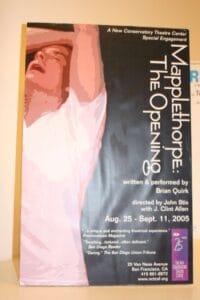
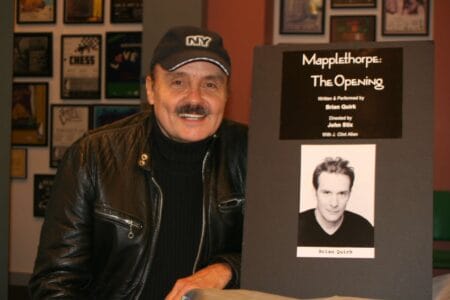
Mapplethorpe: The Opening
“Kisses on Your Opening: Robert Mapplethorpe Hits the Road”
The New Conservatory Theatre; 100 seats; $26 Top
Drama Review
San Francisco. A New Conservatory Theater presentation of a play in one act written and performed by Brian Quirk. Directed by John Stix with J. Clint Allen. Executive producer, Ed Decker. Set, Bruce Walters; lighting, John Kelly; soundscape, Lance Horne; sound engineer, Ted Crimy; dialect coach, Diego Daniel Pardo; production stage manager, Danielle Hill. Opened Aug. 25, 2005. Reviewed September 22. Running time: 70 minutes
Review by Jack Fritscher, author of Mapplethorpe: Assault with a Deadly Camera
Currently playing the road on the way to New York, Mapplethorpe: The Opening is the new one-person show written by its clever lone star, Brian Quirk, who is the first stage dramatist to take on the controversial New York photographer Robert Mapplethorpe famous for his faces, fetishes, and flowers. In 2000, the Showtime film, Dirty Pictures, scripted by Ilene (The L Word) Chaiken, avoided the actual Baudelairean self of Mapplethorpe by focusing on the censorship of that canonical artist whose gorgeously “dangerous” photographs—certainly in an American court first—were put on trial for obscenity in Cincinnati.
At the same time of that Inquisition, the US Senate, driven by Republican Senator Jesse Helms, had a Christian conniption condemning Mapplethorpe in the 1990 senate record in the way Ingrid Bergman had been similarly denounced in the Senate “as a powerful influence for evil” in 1950.
As if Mapplethorpe the person is still too hot to handle, or perhaps for legal issues yet to be cleared, Quirk also sidesteps any impersonation of the actual Robert Mapplethorpe who died of AIDS at age 42, March 9, 1989, one hundred days before the government’s posthumous attack on his work ignited the culture war that virtually destroyed the National Endowment for the Arts.
Quirk’s perfectly queer history lesson should be required viewing for full LGBT citizenship.
Dirty Pictures was an economical court-room drama. Quirk’s Mapplethorpe is set on an even sparer stage—with a floor as white as a sheet of unprinted photo paper awaiting development. Honoring classic unities of time, place, action, the situation is the two-hour opening of the young Mapplethorpe’s first Manhattan show at the Kitchen Gallery in SoHo, 1977, before the Titanic 70s collided with the iceberg of HIV.
The gallery guests impersonated by the quicksilver Quirk is an Our Town line-up of Mapplethorpe family and friends, including his grandmother, his mother, and one of his brothers—seemingly the photographer Edward Maxey who uses his mother’s maiden name because Robert reportedly told him that there could only be one photographer named Mapplethorpe.
Quirk’s cocktail party also parades out art students jealous of their fellow Mapplethorpe as well as even more envious art teachers who lust after the androgynous young Robert. With petard in hand, much like Mapplethorpe’s 1983 self-portrait wielding a very sharp knife, Quirk limns a satire of social x-rays Andy Warhol, Diana Vreeland, and Susan Sontag, as well as assorted sordid denizens of two of Mapplethorpe’s favorite hangouts, Max’s Kansas City and Studio 54.
Quirk eschews Mapplethorpe’s third favorite crawl: the legendary after-hours sex club, the Mineshaft, on Washington Street at Little West 12th Street. There Mapplethorpe incubated his leather-culture photographs, such as “Bryan Ridley and Lyle Heeter,” his portrait “Mr. Mineshaft,” and the first magazine cover of his career in the San Francisco leather magazine, Drummer, issue 24, September 1978.
In a revealing turn, Quirk dares uncork a bravura characterization of Mapplethorpe’s one-time roommate at the Chelsea Hotel, and lifetime muse, rock poet, Patti Smith, who begins Quirk’s show screaming from a recorded CD, “Rock N Roll Nigger,” that she and Robert as outsiders are “white niggers.”
The Quirk-y Patti also scratches her fingernails down the relationship of Mapplethorpe with his fabulously wealthy patron and bespoke lover, Sam Wagstaff, who seduced Robert with the line: “I’m looking for someone to spoil.” A descendent of Thomas Jefferson, upper-crust Wagstaff introduced Robert to all the right people both in society and in the Art Reich so that early on the young photographer was shooting A-list portraits of artists, composers, and socialites including David Hockney, Susan Sarandon, Lord Snowden, Louise Bourgeois, and Yoko Ono, as well as politicians Arnold Schwarzenegger and Roy Cohn.
Standing solo in the midst of all these drama queens, conjurer Quirk (barefoot and in blue jeans, and supported by Lance Horne’s impeccable soundscape) manages to channel, and differentiate, twenty voices at the gallery opening, taking time from those lowlifes and highlifes to strike nearly a dozen langourously lurid poses of famous Mapplethorpe photographs—particularly the sexual and S&M ones. Each is framed by a square of bright white lighting, on the bright white set, lit ablaze by John Kelly’s precise design.
Art critics characterized Mapplethorpe’s photographs as “perfect moments,” and in each tableau, Quirk “becomes” the model posed—and very often sexually engaged—by Mapplethorpe. Breaking the two-dimensional facade of these flat photographs, Quirk, in an inspired bit, speaks the fictive interior monologue of each model revealing their own thoughts about Robert objectifying them as “nigger,” “rubber freak,” “infantilist,” “horse-hung pornstar,” and “fisting bottom.” These exhibitionists are junkies for the voyeurism of the camera, and Mapplethorpe feeds their addiction, coiling around his tripod like the Serpent in Eden, seducing each model out of porno stereotype into the classic perfection of an archetype. Mapplethorpe was Plato with a camera; he shot the formal, classical Platonic ideal. Quirk gets this.
New Orleans photographer, George Dureau, one of Mapplethorpe’s (tor)mentors, who is not (yet) in the play, warned elsewhere that “the camera is a mindless lunatic.” In a brilliant construct, Quirk subtly threads subliminal art criticism through his nondidactic monologues that educate the audience. He keeps his hand firmly on his script to show that no kind of lunacy of sex and drugs affect Mapplethorpe’s formal style. The play is very much about Mapplethorpe’s “eye” which is analog to what his friend Christopher Isherwood signified in I Am a Camera.
Whatever one thinks about the homomasculine subject matter of Mapplethorpe’s luxe leather period, the truth is that he treated fisting as formally as a calla lily, or as a close-up portrait of Lucy Ferry, or as a full-length shot of a nearly nude young Schwarzenegger.
Quirk has learned that Mapplethorpe was not a photographer; he was an artist who was a photographer.
This is the difference between the boy from Floral Park, Queens, and the motor-driven hacks who try to imitate him, while making snide comments in Quirk’s script. In a pulse-quickening final speech, rather much like the chase scene in a one-person show, Quirk builds to a dramatic peak: as devil’s advocate, he reveals that what has been tallied out of this gorgeous, dangerous art is Robert Mapplethorpe’s intricate humanity.
As a compliment to the elasticity of Brian Quirk’s script, a plus of this show is that it might be performed by any actor of any race or gender or age or diversity. One thinks of the versatile Jeffrey Wright and the gravitas he might add; or of a Charles Busch or a Harvey Fierstein as truth-speaking “oracles in drag” impersonating other characters with the flick of a wrist; or Nathan Lane nailing irony where sex and politics collide in camp. Actually, two or three virtually anonymous actors in black mufti could also perform this script in much the same way as a two-man Hamlet recently transmorphed on the Project Arts Centre stage in Temple Bar, Dublin.
Structurally, Quirk’s show—like a Mapplethorpe photograph—demands a frame. Of course, what playwright or actor wants to do exposition, but—reality check!—audiences know or remember little about Mapplethorpe’ personality, his times, and what exactly his photographs look like. Time and censorship are erasers.
So some character, or pair of characters, needs to intone exposition something like: “In New York, in the 1970s, Robert Mapplethorpe was an imp of the perverse…” “…whose gorgeous sex photographs stunned critics and censors.” “He was Satanic; he was talented; he was the Prince of Dark Rooms.” “He was handsome; he was doomed.” “He looked like the love-child of Jim Morrison and Mick Jagger.” “His muse Patti Smith loved him.” “Rich patrons hung his calla lily photos in the dining room….” “…and his fisting photos in the bedroom.” “He shined with sex and beauty…” “…and died young, rich, and famous in 1989 at age 42.” “So fuck him.”
Even though Mapplethorpe copyrights are strictly controlled by the Mapplethorpe Foundation, a full-bodied production could only benefit from projections of the dozen referenced photographs which are never shown.
Audiences who know the arc of Mapplethorpe’s history might enjoy this performance piece more if the word “opening” were metaphor, meaning not just this “opening night,” but the “opening up of his talent, his career, his fame, his cash, his ass, his virus, his Aids charity, and his humanity.” In so oxygenating the unity of time, other pertinent and impertinent Mapplethorpe pals and enemies could crack wise, such as Dureau, hiding his own photographs away from the curious young Mapplethorpe cruising Dureau’s New Orleans atelier for inspiration.
Art queens would levitate over the tart-tongued British critic, Edward Lucie-Smith—who knew Robert early on—quipping, “Robert sold himself like a department store. Holding his portfolio, he would walk up to someone and say, ‘If you don’t like these photographs, you’re not as avant garde as you think!’” Even Senator Jesse Helms reading into the Senate record would be of interest. By redefining the keyword “opening” of Mapplethorpe: The Opening, Quirk’s delightful Mapplethorpe evening could burnish its sparkle with even more wit—rising up to the specific comedy of classic “set pieces” such as “Drop That Name” from Bells Are Ringing or the slice-and-dice of Cole Porter’s “What a Swell Party This Is.”
Finally, given the erotic attraction of the Mapplethorpe name and ouevre, this show could pack houses nightly if future producers cast one or two well-built actors to perform the parts, and the dialogue, of the naked models in the photographs. In fact, the boards (and bones) under this “history play” almost demand such flesh and blood.
Such “opening up” of Quirk’s cost-effective, engaging, and fascinating stage play would be creatively correct—and good box office. Mapplethorpe contemporaries Warhol, Basquiat, and even Valerie Solanas, have each been assayed in dramatic films. (One also thinks of films about artists ranging stylistically from Paul Schrader’s Mishima to Ed Harris’ Pollock to the bio-pic of the two artists most like Mapplethorpe, Rimbaud and Verlaine, in the extraordinary bio-pic, Total Eclipse.) Going on twenty years since his death, it’s time for Mapplethorpe: The Movie. Quirk should take a crack at it, and call HBO. © 2005 Jack Fritscher