Take 2: Introductory Phone Call to George Dureau (Part 1)
In this George Dureau interview phone call, recorded on August 26, 1990, Jack Fritscher introduces himself to the New Orleans painter-photographer as a writer and friend of Robert Mapplethorpe. Dureau talks about how his photographs grew out of his paintings and drawings, his humanist “family picture” approach to his models, Mapplethorpe’s visits to New Orleans and Mardi Gras, and how Mapplethorpe bought Dureau’s photographs, among them Wilbert Hines (1977) and Oscar, and used some as points of departure for his own work. This is Take 2: Part 1, of Dueling Photographers: George Dureau and Robert Mapplethorpe. The call continues in Part 2.
Continue to Part 2
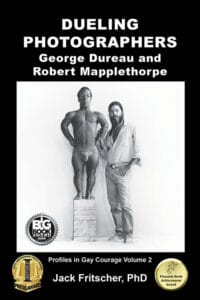

WINNER! 2025 Independent Press Award – LGBT Non-Fiction
SILVER: 2025 NYC Big Book Award – LGBT Non-Fiction
WINNER 2025 Pinnacle Books Achievement Award
Dureau Speaks
August 26, 1990
Jack Fritscher: Hello. This is Jack Fritscher. Is George Dureau there?
George Dureau: This is George Dureau.
Jack Fritscher: George! How nice to talk to you. I’m a writer and a friend of Robert Mapplethorpe and have learned of your work from Keith Ardent who, when I was talking to him the other day, said, “There’s this New Orleans passage in Robert’s life that someone should pay attention to and the man there is George Dureau.” I was wondering if you might consider my making a telephone appointment to ask a few questions.
George Dureau: Yes. Are you writing a book or what?
Jack Fritscher: I am. May I record this? To make notes? I won’t take much of your time.
George Dureau: Of course. Ask away.
Jack Fritscher: I’ve been working on my Mapplethorpe book off and on since 1978. A couple of chapters are based on my feature articles about Robert. I’m not so much interested in the controversy about him as I am in presenting him as a person. And in your case, as your student. People have heard he had a mentor, but they think it was Sam Wagstaff.
George Dureau: So you see him as he was?
Jack Fritscher: As I saw him for three years when we were together. Robert has been lost as a person in all this controversy over censorship. What I’m trying to do in my book is present him as a person who, as with all young photographers, had teachers, mentors, friends. You helped him along and taught him things about photography. Robert was not born to the camera. The camera found him.
George Dureau: I knew even less about photography than he. We may have started photographing about the same time, but because I’ve always drawn and painted, when I picked up the camera and started making pictures, they looked like my paintings and drawings. So the precedents for whatever he got from me come from my paintings and drawings of men. Robert was much more a student of photography than I. He and Sam had gathered up a collection of historic pictures by all kinds of photographers and Robert studied them and distilled them into what he wanted his work to look like.
I must say, I never thought about what my own work would look like. It just looked like my painting. Robert certainly never came to me to learn anything. He saw some of my photographs at Robert Miller Gallery. He and Sam were reviewing my work, and fell in love with a couple of them. He wrote me a letter and asked could he buy one. So he bought that first one [Wilbert Hines, 1977], and he continued thereafter to buy them, and I must say that they influenced him a lot.
I’m very much a humanist and I’m very involved with the people I photograph. My pictures are family pictures. Very sentimental, shall we say. They’re very humanist. And that was highly inappropriate for the New York market he was aiming at. Sam, not even for one moment, would never have tolerated Robert photographing people with as much compassion as I did. Quite true.
Robert, looking through a large stack of my photographs, just kept staring at me as if to say, “You must be crazy to like these people.” My pictures quite clearly say that I like everybody that I photograph. So anyway, Robert cleaned them up. That is, he used some of the aesthetics of my kind of old-fashioned good posing that I had developed over twenty or thirty years of work, but he made it into a much more stylized, art-for-art’s-sake kind of art which suited him and the much more chic audience he had in mind.
The New York people to whom he appealed, none of them, were as compassionate as the people in New Orleans who were amused by my pictures. There was a coldness about his work, either because he was like that or his audience was. He always used to sort of smile and give a “Ooh, how could you do it?” look about my pictures being so tender and involved. He came around here a good bit, you know.
Jack Fritscher: So you knew him rather well. Personally. And through your lens.
George Dureau: Yes. I have a good many photographs of him, and some he took of me down here. There’s two or three really lovely ones of him. One that I took when we first met face to face, 1979, I guess, and then I also took some later when he was not as well, looking a bit bedraggled. I don’t know when that was, maybe 1985.
He came down here and stayed in the French Quarter. In those days I had a big house right outside the French Quarter on Esplanade [Avenue]. Now I live in the French Quarter. We went out together. Ran around together. He had that sweet baby-sister behavior. A come-hither kind of behavior.
We shared quite a bit of the same taste about men we liked, but I don’t think there was any similarity about our sexuality. I’m an old fashioned Greco-Roman patriarch queer, not a flip-flop queer. I mean, I’m the dominant male about the house. I have a lot of gorgeous boys who work for me and do things for me. My house is a kind of colony of the underclass, but I’m Big Daddy always. I’m not anything similar to his sexuality which, I believe, was much more modern gay.
Jack Fritscher: It was. It’s a perfect hook to talk about because I had many of the same observations about him myself during our affair.
George Dureau: Well, let’s consider the people. It’s wild the tenderness I afford to my models. They’re my children. They’re usually people that I’m doing for, like they’re adopted. I keep them around so when I hire them to model, it’s quite different from Robert’s one-shot thing. Bring them in, shoot them, pay them, throw them out.
Robert asked, “How can you get them so cheap?”
I said, “You can get them cheap if you don’t mind having them for life.”
Where he would pay $400-$500 to get them to drop their pants in front of the camera, I would seduce people because I loved them and then I would have them to dinner or for life, to paint from or to draw from or to fuck or to photograph. If I paid them $100 to pose for me they would be back the next day anyway to get money to pay their momma’s rent or the water bill or something. I could have paid them $1,000 and they’d still be back.
It’s so different when you live in a congenial little town like New Orleans. You can’t shoot them and leave them. At any given time, I have two or three at the door, even though I’ve found out they’re not people I want to spend the rest of my life with. I have discretion. I have to be a bit choicey, but not too much. I still get enamored by someone’s appearance and bring him home.
Jack Fritscher: When you and Robert went out, how did you find him to be? Was he predatory? Did you find him under the influence of drugs?
George Dureau: When we were out, Robert would always have to go home to make a pit stop for his powders. I didn’t have to. I did smoke in the 60s and a little into the 70s. I used to be quite an alcoholic and drank quite a bit, but I’ve never been addicted to drugs. So we had a different mentality. The drugs matched very well with his hard vision of what people could do for him as opposed to my sort of Big Daddy way of what I’m going to do for them. It’s a very funny thing. I see people as somebody I might adopt, do for them for awhile, while Robert would see them as “What’s this one going to do for me tonight?” His was a very modern-day gay behavior, but not something I could do. I think it ties in much more with drugs and immediate satisfaction. I’m the king of low-key living.
Jack Fritscher: I tend to be more like you.
George Dureau: Where do you live?
Jack Fritscher: In the countryside north of the Golden Gate Bridge. Just so you know, because you mention Big Daddy, I wrote my dissertation on Tennessee Williams. So I get it when you call yourself Big Daddy.
George Dureau: Tennessee lived right around the corner from me.
Jack Fritscher: Ah, the Vieux Carré.
George Dureau: In some ways, I’m the older Big Daddy and someways I’m the younger Brick [two characters in Cat on a Hot Tin Roof]. I looked at myself when I was thirty-five….
Jack Fritscher: The average age of a leading man in Hollywood…
George Dureau: …back when we all had long hair in the early 60s, and I would go into hippie bars with hip people. And then I looked in the mirror one day and it dawned on me that I had attained the age of my own fantasies.
“Oh, my God,” I thought, “now you’re a daddy!”
I suddenly became the daddy instead of the pursued person and I must say it’s the best thing that ever happened to me. So many older queers think they’re “something” and hold themselves royally apart for no good reason. I just think being older gives me more advantages to offer more to the cute things I would much rather pick up.
Jack Fritscher: Robert was that way in a sense. He was very good looking, but he was that type. Aloof. Objectifying. Everything he did around leather guys he met was an audition for his photography.
George Dureau: Yes, it was. I however still do blind “fall-in-loves.” I have this immediate passion for almost all human beings which is incredibly stupid sounding, but I give everybody one hundred percent. Then I let them chip away at that. Essentially I just love people unreservedly, whereas he!
Let me tell you a story. He was here one Mardi Gras and we had an absolutely splendid time out in the cold cruising the Mardi Gras parade and crowd. Now this was swell to him like he was paging through a book of beauties or something. I was his wingman.
I’d say, “Look at 3:00 tall and skinny, tan, eyebrows.”
And he’d say, “Look at 9:00.”
We’d do this sort of behavior, walking through the crowd, the endless, massive crowd, especially when you went down to Canal Street, the main drag. Do you know New Orleans?
Jack Fritscher: From music, movies, and books. When my husband Mark Hemry was younger, he often went to Mardi Gras and has stories to tell.
George Dureau: Canal Street is the main drag, but it’s also the meanest street because that’s where most of the black people hang out, on the main drag, and so we could go cruise through them. Actually, that may have been my best time with Robert because the fun of seeing them and cruising them was what we enjoyed the most. What happened with them after he saw them, or I did, was so dissimilar, it was strange.
We’d go into a black gay bar. There’s many, but they’re not the kind of places I can go into because the city is so small. The guys would be all over me because they want me to photograph them or hire them for a little job around the studio. They know me too well.
But I did take him around for a little education.
We’d go into a black bar and find someone he thought was fabulous looking. Then I’d drop him home with them, but often as not he’d say later, “Oh they weren’t any good,” or, “They wouldn’t do the right thing.”
I would think: that’s odd. He liked them when he saw them, but when they didn’t do what he wanted, or come up to the New York standards, he complained.
As a matter of fact, when I moved to New York in the 60s, it took me no time at all to find I was not going to perform up to the predictable New York pattern. I was far too romantic, yes, and came on sort of “southern literary” or something, southern country behavior, country compared to New York. There was a gentility to my life before I went there. I thought, “My God, if I stay here, I’m going to have to give up everything I hold dear.” I stayed about nine months.
Jack Fritscher: Do you think Robert’s urbanity tripped up his humanity?
George Dureau: I don’t know. I just saw how he acted in New Orleans. He could pick up anybody he wanted to, but you don’t have to behave that sharp way in laid-back New Orleans to pick up people. They’re all over the place. I find my satisfaction in having a more humanist relation with people.
I’m fifty-nine. I’ll be sixty in December. I’ve been laying men, devotedly laying people, since the 1940s. I’ve changed some with age, but back then I would go dancing and have a riotous good time in the Spanish or Greek bars. If you fell in love with somebody, wasn’t that wonderful? And if three months later they screwed you over, well, that was just a different period. You could fall in love with a sailor and wait for him to come back from some endless war.
Jack Fritscher: Like Tennessee Williams’ maimed young Navy sailor in his French Quarter story, “One Arm” [1948].
George Dureau: Yes. The Quarter was full of sailors and soldiers from World War II and Korea and the Army. I was in the Army myself. I seduced a mountain of people. I didn’t go for sex first. I went for romance first. I worked at it because sex was a wonderful jewel in those days whereas today it’s thrown out on the counter like meat.
Jack Fritscher: What was Robert like when he went into a black bar with you?
George Dureau: Oh, just the usual petulant leather boy standing in a corner of the bar and scowling at people, then sort of sidling over to them and whispering something. He acted the same way in New Orleans as he would in a New York bar, looking petulant and kind of drawing them close into him whispering sex and drugs. I don’t do that. I don’t know how to do that. I ask them about their wives and children.
Jack Fritscher: Robert liked figuring out what drugs might make people available. He liked MDA.
George Dureau: He didn’t have enough confidence in his own charm. So he always offered them drugs. That’s the cheap and easy way to do it. He knew that I didn’t object terribly to his taking drugs. I didn’t participate. A joint once in awhile. I’ve never used coke.
Jack Fritscher: Wally Wallace [Manager of the Mineshaft bar in New York who allowed Robert to shoot Mr. Mineshaft, David O’Brien, 1979, on location] introduced him to black bars in New York and told me for the record on video that when he took Robert into his first black bar, he was terrified, and yet he went around wearing that lapel button that said “N-word.” So…
George Dureau: Well, that was a real problem with him, that N-word thing he had.
Jack Fritscher: Like a fetish-trigger buzzword that made him hard, something he could say to a partner to propel a scene.
George Dureau: I can remember one time he brought a rather cute black man back from a bar to my home. In this small town, I recognized him. So you can see one of the problems in New Orleans is sexual history. I’ll see a guy who is twenty-eight-years old, handsome, and good looking, and I remember him when he was my paperboy because I go so far back, because I’ve been a recognizable nice man who is an artist who will lay you if you want it. I go way back. I’ve laid their big brothers. So Robert would see somebody cute who turned him on because he seemed real scarey. So I’d have to be careful not to disillusion him and say, “Oh, yes. He used to be my delivery boy.”
Jack Fritscher: He needed that mix of beauty and terror.
George Dureau: Exactly. So one time when Robert was staying with my friends, he took home somebody who was quite handsome. I had an idea who he was, and the next morning Robert came over to have breakfast with me.
He was often the houseguest of my friends Russell Albright and Michael Meyers. Russell is a radiologist and Michael is a decorator. They have a big gorgeous house here, and they bought a lot of paintings from Robert Miller and they’re sort of art climbers. So they would make a “Big Score” saying, “Oh, Robert’s staying at our house.” Okay, fine.
It would not be fun for Robert to stay at my house because I work all over my house all the time in my big live-in studio. But it was fine for him to stay at Russell’s because there’s a slave quarters building across the patio, and more guest rooms in the big mansion. So I knew they would find a nice place for him and give him all the liberty in the world because they don’t make guests have to eat with them or drink with them or anything else even though they’re quite social.
So anyway he would stay over there and come over the next morning to my place, and I would say, “How was Danny boy?” Or whoever.
“Oh, not too good.”
“Why not?”
“Well, he didn’t want to do anything.”
“I can’t believe he didn’t want to do anything.”
“He wouldn’t say, ‘I’m your N-word.’”
I’d go, “Huuuh?” I’ve been accused of being a colonialist, accused of keeping slaves, and all sort of things, but I have this cordial, sweet saintly behavior with my darlings. And I’d say, “He wouldn’t say, ‘I’m your N-word?’ Isn’t there an alternate? Like, ‘Oh my darling I love you?’”
Robert would say, “No. Why couldn’t he say, ‘I’m your N-word?’”
Well, do I have to explain why it’s hard to say that?
I’d say to him, “Look, if you said, ‘I’m your cocksucker,’ it might be a trade off for him to say, ‘I’m your N-word.’ Even so, why do you want him to say it? The problem is on your side, not on his.”
We all have horrible fascist politically incorrect scenarios that go through our heads, but no one need say everything that comes into their head. You maybe create a private fantasy around a look in a certain picture, or around a guy, and then you hold your dick a certain way that turns you on, and then you lean up against something and fantasize two people falling in love with you, or something, and Whammo! It all adds up and you shoot your wad. It’s often some kind of fetish scenario that comes out of your deepest past. It’s okay, but I think it’s so odd if you can’t do it any other way. I mean that somebody had to open his mouth and say, “I’m your N-word.” I mean in your head you could pretend that by his actions he was saying, “I’m your N-word.”
Jack Fritscher: Floral Park where he grew up is very white. [Less than two percent black in 2020] He never said anything racist around me.
George Dureau: For all that, he would sometimes act like I was living a sweeter, warmer life than he. A couple times he wanted to come down and spend a couple of months here, but it never worked. He’d stay a week or two. He’d love it, but he couldn’t stay off the phone, keep from doing business. He was just so ambitious to be well known.
Jack Fritscher: It’s the American Dream.
George Dureau: Once he came down and said, “What have you been doing?”
I showed him some drawings and paintings.
He said, “No, Who have you been photographing? Got anybody new?”
I said, “I have new ones all the time. How about these?”
He’d look at the pictures and say, “Oh, look at him!”
I’d say, “Well, he’s nice. but he ain’t gonna say he’s your N-word.”
He said, “I haven’t photographed any N-word I want in six months.”
“Really?” I said. “What are you shooting?”
“Oh, I photographed some horses and some ads for Cardin.”
I said, “Haven’t you done any easel art or something you enjoy?”
No?
Well, I thought, what a price. First you’re famous and then you have to hurt yourself more. I’d like to be that famous, but his fame is so gigantic that it shits all over me all the time because it’s so hard for people to understand that I am me without any need for Robert. He doesn’t have anything to do with me because he sort of laid a wet blanket on everyone with his style.
My pictures, because they have other stuff going on in them, look less pure than his because they’re not as stylized, as abstract as his. I’m much more concerned with the person, the whole human item. Do you know my work at all?
Jack Fritscher: Yes. I’ve seen your British photobook [George Dureau New Orleans. 50 Photographs, Introduction by Edward Lucie-Smith, GMP, London, 1985]. I know Ted Lucie-Smith who often stays in our guest room. And I appreciate your vision.
George Dureau: My pictures are like a record of a romance which is a big difference from him.
Jack Fritscher: Yes.
George Dureau: I’m romancing everybody who has ever appeared in my photographs. I have hundreds of pictures of the same people because they come back year after year and I photograph them. Sometimes it’s hard to choose what to do with them, but each shoot I try to photograph different aspects of their personality.
Jack Fritscher: Robert went after the abstraction of a person, the platonic ideal.
George Dureau: That abstraction sometimes happens in my paintings because I sometimes talk the person into an ideal pose although I still keep some contact with their faces and personality. When I decided to make some photographs of the people I was painting and drawing, I had to resist the particular obvious things the camera was dying to shoot. I didn’t want to spend my life taking literal pictures of a pair of big brown eyes with lashes on them, or of handsome amputees.
I used my camera as another way to get inside each person. My photographs also allow the person to “talk” which my paintings can’t very well do. In my photographs, I have the person speaking back at you by looking back at you which, unfortunately, can make viewers feel guilty.
Jack Fritscher: Well, it’s a shock to racist history when a black man can make direct eye contact with a white viewer and survive.
George Dureau: That’s why some of my photographs were odious to some collectors like Sam Wagstaff, but not Robert who bought them. He had about thirty. He’d study them, take hints out of them, take the humanity out of them. He liked that my pictures would frequently make viewers feel uncomfortable. He wanted that with his pictures. I go nose-to-nose, beard-to-beard with you as the viewer, and then kind of come back at you again, and sometimes make you downright embarrassed.
Jack Fritscher: Your pictures have a gentle social consciousness. Robert’s were rather aggressive acts of art for art’s sake and commerce’s sake. His leather pictures were like stills from a play in the Theater of Cruelty that assault an audience. The subtitle of my Mapplethorpe book will be Assault with a Deadly Camera.
George Dureau: “Assault,” yes. His pictures were political, but a different kind of politics from mine. Somebody wrote, and this is very interesting, that his pictures belong to a speculative concept of art.
Jack Fritscher: Which is the gateway drug to the joys of pornography.
George Dureau: Yes, because his photos were like the reclining nude female painting hanging over the bar in a western cowboy saloon. It’s hanging up there quite passive, invitational, for horny men to speculate on and use in their heads as they will. But mine do the opposite twist. My pictures flip the dynamic. My pictures look back at the cowboys looking at the picture. You hear what I’m saying?
Jack Fritscher: Yes.
George Dureau: It was a funny point, but it’s kind of true. Robert’s politics suited the gay mafia he catered to. Wagstaff was a real fascist.
Jack Fritscher: How so?
George Dureau: Wagstaff despised minorities. Not that anybody has to love them. I am one, but they piss me off sometimes too. Wagstaff really hated the whole idea of anyone saying anything nice about the poor.
Jack Fritscher: Do you think that attitude applied to Robert’s women as well? When I look at Robert’s women, I wonder if his gay eye was reductive around women. There’s a certain passive deadness about them [Lucy Ferry, 1986; and about men, like the deadpan, Roy Cohn, 1981]. As if they’re masks. Maybe he thought deadpan photography was cool.
George Dureau: But he’s done that deadpan with practically everybody. There are very few of his black men that will look at you, except in a kind of odd sexy way. He bought one picture of my model, Oscar, and basically re-shot his version [Bob Love 1979]. He got it straight out of me. It was not the first picture [Wilbert Hines, 1977] he bought from me, but it was the very first picture of mine that he took a ‘departure” from.
My friend Oscar himself had a pockmarked face and big bulgy pretty eyes that made him the king of peering out at you from the corner of his eyes and Robert did his “departure” of that picture [Bob Love 1979], and put it on the cover of his [pre-AIDS] Black Males [Galerie Jurka, Amsterdam, 1980, preceding his AIDS-era Black Book, 96 erotic photos of black men, St. Martin’s Press, New York, 1986]. It’s the head leaning forward. He’s looking off to the side. Robert had my photo of Oscar hanging in the hall right next to his bedroom when he was dying.
There were three or four more of my pictures that he also took as points of “departure,” one being the guy leaning on a mantelpiece named Wilbert Hines. The lighting and everything just intrigued Robert. Wilbert was the first one he bought. I didn’t know Robert then. He had seen my work and wrote me and asked could he buy it.
Another one he bought was of a model who has little deformed arms, and a fierce expression. I photographed him with the arms curled up under his chin and I made three big 16x20s that Robert bought from the show because the lighting intrigued him. There’s a big diagonal in the background and he went cuckoo over that.
Then there were two more that I showed in New York. One was Dave Kopay, the [gay] football player, sitting sidesaddle with his arms around his knees and his dick and balls hanging out [David Kopay, 1982]. The other one was a nude black boy [Leonard Frazer (with Clarinet) sitting with dick and balls hanging out. And those sort of went together to make Robert’s picture of a black boy sitting on a pedestal [Phillip Prioleau (on Pedestal Side Facing), 1979, Z Portfolio].
I photograph a lot. I don’t make a big deal out of it. I get these spells to do it. I might feel I love this person. So I’ll take eight or ten rolls in one afternoon and maybe later just select one frame from it all. I do have a lot of negatives. Sometimes I go back and I see something in a picture, and I’ll say, “Oh, my God. Robert must have loved this one.”
My assistant [Jonathan Webb] would shake his head. “I know you love Robert. You must have had a good time together.”
Robert would never go out cruising with Jonathan and me. He always felt that Jonathan was too quiet and vegetarianish. And Jonathan always felt wrongly he was not sophisticated enough for Robert’s company.
And Jonathan would say, “Can’t we hide these pictures when he’s here? Because you know they’re going to turn into Mapplethorpe pictures if you leave them sitting out here on the table.”
It was the kiss of death when Robert would buy something. It was like he was paying a token price for what he was going to do with that picture. Put it in the Big Time! It was funny because he would drain the soul out of it. That big slice of soul was not an acceptable commodity to him. That soul that I shared came from my personal experience. It wasn’t public domain.
Jack Fritscher: I find soul in Robert’s pictures of Patti because he loved her. In his book Some Women, the last four pages are of her, and she looks, now, like the grieving Mrs. Mapplethorpe. But the other women in there, even Yoko Ono, I don’t know. There is something dead about his sleeping beauties. [The ghostly floating face of Doris Saatchi, 1983]
George Dureau: I don’t know how he acted with his models. Did he photograph you?
Jack Fritscher: Yes. Many frames. Also, in a kind of double-selfies, he shot the two of us curled up around each other.
George Dureau: He photographed me with one of my black models in New Orleans. It was a really nice photograph. I’d been photographing an old house, and I sort of came up with idea. The house had huge columns, and we stood on either side of these huge, battered columns. [George Dureau (with Crouched Black Male in “Black Cobra” Sweatshirt), 1982] While it was my idea to stand there, Robert took the picture.
He wasn’t very manipulative. He didn’t spend a lot of time moving us about. I imagine that he must have spent a great deal of time directing people who were important to him, especially when he was desperate to make a good picture on commission, but he didn’t fuck with me much in front of the camera when he photographed me as I didn’t with him. Maybe it was because we knew too much about the thing. We didn’t want to expose ourselves.
On the other hand, I downright seduce the people I shoot. I put them through all kinds of directorial changes. I make up all kinds of stories to liven them up. “Oh, let’s do this one as if you’re waiting for the bus to come and get you.” I’ll babble at them and stroke them, and once in awhile we’re having sex when I take the picture. I play with people a lot. I don’t mind stroking them and kissing them and carrying on. Sometimes my pictures are foreplay or afterplay as the case may be.
Jack Fritscher: I do the same verbal directions minus the sex when I shoot my video models. I tell them to put the sex into the camera for the viewers. I’m a writer, but I do a lot of magazine photography as well.
George Dureau: What kind of camera do you use?
Jack Fritscher: Minolta Maxxum.
George Dureau: Robert and I accidently used the same camera and the same paper and the same film and all that makes the pictures look similar. He had much more expensive equipment than me. When I began photography [1971], I used the light coming in the windows, with a little bit of fill light and then I got two more lights, but I’ve never been very technical and never spent much money on equipment. Essentially because Robert and I used the same film, paper, camera, and format, there’s a similarity in the velvety quality.
Robert never photographed a black until he met me.
That’s why he bought my pictures.
He asked me how I did it and like a fool l told him.
He told me he hadn’t shot any black men, but he may have experimented.
He said, “I can’t believe how you can get them to look like that for you.”
Jack Fritscher: It was your relating to your sitters.
George Dureau: I think that he wanted to get rid of them as soon as he shot them. I know he would sometimes have major plans for a person, but I don’t do that. I don’t decide that this model is going to be my husband for life. And I don’t do the opposite and throw them out after I’ve shot them. I enjoy our relationship that’s nice while it lingers. I don’t predict what our relationship has to be.
There was one picture Robert had of a sailor, the one with the big dick hanging out of the polyester suit, Melvin? [Milton Moore with whom Robert had a tempestuous relationship: Man in Polyester Suit, 1980]. I’ve lost his name now. Anyway, he thought that was going to be some big life-long affair.
One time he said, “I wish I could find a smart one.”
I said, “What do you mean, a smart one?”
He said, “You know. I’d like to find a good-looking Bryant Gumbel or something.”
I said, “Why?
Jack Fritscher: To see if he could find a what?
George Dureau: A good-looking Bryant Gumbel [handsome television host of the Today Show].
He said, “I want one who has a brain of his own.”
“Why? So he doesn’t hang on you?”
“Yes.”
“But Robert, if there was a black man who was brilliant and had a successful business, why would he want to go into a corner and say, ‘I’m your N-word’?
What a success.
Jack Fritscher: His camera was a power tool.
George Dureau: I get embarrassed about things he did that I don’t do. Things that are hideous to me. I don’t know about the scat issue with him. I know he was into it one way or another, but I don’t know what was going where, do you?
Jack Fritscher: No. That was not part of our scene. When he shot grande dame Katharine Cebrian in San Francisco [Katherine Cebrian, 1980], he did have SHIT spelled out in big silver studs on the back of his leather jacket. It was his bad-boy charm offensive.
George Dureau: Oh.
Jack Fritscher: When I was involved with him romantically, I should say “intelligently,” he said what he wanted was “intelligent sex.” I told him that some of his New York scenes were not my California scene. We had words about hygiene that [in 1980 before AIDS] turned our sexual relationship to friendship. I think I may be one of the few people who ever said “No” to Robert Mapplethorpe.