Take 2: Introductory Phone Call to George Dureau (Part 2)
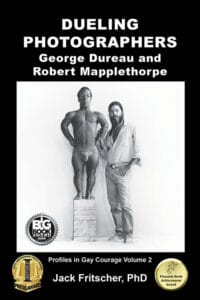

WINNER! 2025 Independent Press Award – LGBT Non-Fiction
SILVER: 2025 NYC Big Book Award – LGBT Non-Fiction
WINNER 2025 Pinnacle Books Achievement Award
Read Part 1
George Dureau: Have you been published?
Jack Fritscher: Since a wee gay boy of seventeen.
George Dureau: What’s your recent work?
Jack Fritscher: My new novel is Some Dance to Remember: A Memoir-Novel of San Francisco 1970-1982. It was published on Valentine’s Day [1990].
George Dureau: Oh, yes. Jonathan is reading it. When we started talking, I had a feeling I knew who you were. Jonathan loves your book. He tells me some things in it from time to time. I’m wildly dyslexic so I read very little. So don’t feel insulted. I try to put out of my head what people tell me they’ve written because I know I’m never going to get to it, because I’m the worst reader in the world.
Jack Fritscher: It’s a lot of reading for anyone, five hundred pages about the 70s in San Francisco.
George Dureau: Jonathan says it’s quite wonderful. I go to cocktail parties where he was talking to people about it and I was embarrassed not to have read it.
Jack Fritscher: Don’t be. You can say you talked with the author.
George Dureau: There’s something in it about you and Robert.
Jack Fritscher: The novel is dedicated to him. He’s not in it, but his presence is felt in the fictional narrative about a photographer. Real people walk through alongside fictitious characters. There’s a scene at the Fey-Way Gallery that is based on Robert’s showing there.
George Dureau: Didn’t he use another gallery in San Francisco?
Jack Fritscher: He used Edward DeCelle’s Lawson-DeCelle Gallery [80 Langton Street] for his leathersex pictures downtown near the leather bars South of Market Street, and the Simon Lowinsky Gallery uptown near Union Square for his polite pictures.
George Dureau: I’ve begun pursuing a few galleries. I’m having a show with Fahey-Klein Gallery in LA.
Jack Fritscher: How wonderful. I’ve talked to David Fahey a number of times.
George Dureau: Well, I haven’t. I’m leaving everything to my gallery manager here. He loves to manage things and keep everybody apart. I probably should give Fahey a call.
Jack Fritscher: He’s very sweet on the phone.
George Dureau: I should certainly call him because he would probably like to know something more about me than what he’s been told. What happened was he had several of my pictures. Do you mind staying on the phone for so long?
Jack Fritscher: No. Absolutely not. I’m all yours.
George Dureau: At one of the Chicago exhibitions, my gallery [Arthur Roger Gallery, his dealer since 1988] and Fahey decided to bring some of Witkin’s work [Joel-Peter Witkin, b. 1939] down to New Orleans. They wanted to do a small show here, and I got the benefit of a trade-off deal.
I was embarrassed at first because Arthur had just a few of my works at the gallery and at first there wasn’t that much of a response, but then all of a sudden, Arthur sold eight of my large prints and took orders for twelve more. So all of a sudden, there was this live reaction. So I get to have a show in February. Which is fine with me. I’m going to create, which is a first for me, a suite of eight or ten photographs that are real allegorical kind of compositions.
Jack Fritscher: Based on your paintings?
George Dureau: Well, based on what is in my head. There are some useable things in my paintings. My paintings are big and allegorical, not very complicated, not in the sense of neo-classic allegory. They are big, bland, kind of as if Cezanne painted people. I’m somewhat influenced by Manet too. There’s a lot of flesh in my pictures. They’re big, over life-sized, and very sexy. I draw very well. The drawings are frequently kind of unfinished looking, but I draw very naturally. Anyway, I’m going to have a show there in February.
Jack Fritscher: Congratulations.
George Dureau: A man in Seattle [Dan Fear] runs the Silver Image gallery [1973-1993]. He included me in a group show [The Nude: Classic & Erotic, July 19 – September 1, 1990]. He wants me to have a solo show too, and there’s another gallery up there. It looks like the West Coast has discovered me all of a sudden. I wonder if it’s because of Christie’s selling so many of my photos when they sold so many Mapplethorpe pictures right after he died. Do you know there’s a gallery in New York called Robert Samuel Gallery?
Jack Fritscher: Yes. Robert’s longtime gallery [795 Broadway, opened November 1978].
George Dureau: Sam Hardison [Robert Samuel Hardison II (1942-1991) whose name fronted the gallery he managed in which Mapplethorpe and Wagstaff were active silent partners] talked me into showing there. I don’t know if he’s still alive. I think he is. I guess he’s in Provincetown now.
Jack Fritscher: Some of Robert’s work has been reproduced as greeting cards by a group in Provincetown. In fact, I set up a shoot for Robert with my then lover Jim Enger [Jim Enger, 1980] who is a championship bodybuilder. It was supposed to be a private thing Robert was doing for me and Jim for fun, but Jim was so gorgeous Robert couldn’t resist making him his “model.” Jim didn’t fancy the switch. You know what happens when stars collide. The star bodybuilder and the star photographer. Jim refused to sign a release until after he saw the pictures. Somehow one of those shots was published as a greeting card of Jim’s torso from the back with no head in the frame. [Other published Mapplethorpe photos of Enger, unlike the private originals Robert gave me, do not show Jim’s face.]
George Dureau: Really? Because that’s really trashy if that’s what Sam [Hardison] is doing because Sam has had trouble like that before. Where did he get the photographs?
Jack Fritscher: Probably from Robert.
George Dureau: Robert sued Hardison to get back works that Hardison had stolen from him. He stole an enormous amount of stuff from me and others. Witkin and others. I didn’t care to spend three years of my life fighting over the prints. So I wrote Hardison a scorching letter, told him to go fuck himself. What happened was there are notoriously gay couples who own galleries and talk themselves into thinking that they’re going to make a great big go of everything. They think their intentions are so good and so noble that it will all come out okay. Anyway, Hardison would give work of mine to these eager people who would back him, keep him afloat, and then they’d flop. So an awful lot of my pictures were never returned.
They would periodically pop up at Christie’s or somewhere like the Ace Gallery in LA. Ace got in touch with my gallery here and sent a whole lot of Xeroxes and asked would we identify the pictures. They were 8x10s and 11x14s that were meant for publicity. Robert Samuel might have sold them all off. So my pictures are drifting around the country all over the place, all these things of mine that Hardison confiscated and sold.
Hardison did buy some of Robert’s pictures from me. I still have a few of his prints. I’m thinking of selling them. I think now might be the best time to sell them.
Jack Fritscher: Dead Celebrity Syndrome.
George Dureau: I don’t think the market can go up. I have the polyester picture [Man in Polyester Suit, 1980].
Jack Fritscher: That’s a main signature photo, of course. It’s been in the center of all this controversy, in the Congressional Record, So that should command quite a price.
George Dureau: I have that one and I have another one. It’s on the cover of one of his books from about 1979, I think. It’s a white boy wearing thermal underwear, but just the boy’s head was on the cover [Likely, Robert Mapplethorpe: Foto’s/Photographs, Galerie Jurka, 1979]. I have the whole original picture where his hand is like squeezing his nuts. It reminded me of what my drawings look like. Once when Robert wanted to give me one, I took that.
Then he printed another one for me as a birthday present. I may have the only print of it. I don’t like it much. It’s has a smear on the lens or something. It’s in a circle which is a mockery of my stuff which is frequently in a circle in a few of my photographs, but more so in my drawings and paintings inside circles. His picture shows a mean looking, tough little Spanish guy, maybe a kickboxer, making a fist, but it looks like a mockery of my style. I don’t know why he made that picture for me.
Jack Fritscher: Maybe to acknowledge you. Like a student turning in homework for extra credit.
George Dureau: It may have been more about the type of model he thought I’d like. I have one or two people who fancy they’re a model and they’re wonderful. I like the complete innocence of somebody who is at last being given his chance to speak to posterity through my camera.
I’m kind of slave to my models, in the camera, but not in painting. I serve them with my camera somehow because I think it might be their only or last chance to say who they are, particularly if they have one arm with a scar on one cheek.
It might be their one chance to speak to posterity. My camera gives them voice. So I frequently, always, let them do a couple of their own poses because they seem to crave something that they’ve been saving up for years. I give them space, step back, and kind of rearrange their ideas and hope for a compromise between my idea and their idea.
Jack Fritscher: You say you’re a slave to your models in the aesthetic sense. Do you think Robert might have been on a leather-bar master trip to some of his models based on his urban Plantation Fantasy of wanting them to be his N-word slaves?
George Dureau: Yes, which is comical. The master photographer dominating them to express what he wanted. What did they want? When I shoot them, it’s noblesse oblige on my part.
I said to Jonathan once, “Why is it, you think, that men who look perfectly big and tough and fierce on the street, why is it that they know that I’m the fucker?”
He said, “Honey, any man who wants to get fucked knows a fucker when he sees one.”
I think it’s my Minoan profile. I’ve got an exaggerated profile and I always think of it as my Minoan profile, you know, like the pottery. Pottery that has satyrs and whatnot with very strong profiles. My hair is in a tight little braid down my back. I have a rather garish, deep profile.
Jack Fritscher: Have you done any self-portraits with the camera?
George Dureau: No. Not with the camera. In drawings.
Jack Fritscher: What do you think of Robert’s self-portraits?
George Dureau: I think they’re great, but they’re pretty. I’ve never done that — made myself pretty. I’ve thought about doing it, but it may be too late. It’s an odd idea to pose yourself pretty, like a lady. I didn’t dress like a girl when I was young. I’d dress with ribbons around my dick hanging out or something, but I didn’t dress in ladies dresses.
Jack Fritscher: Off camera, Robert didn’t either. Gender bending was popular back in the 70s. David Bowie. Men with beards in glitter drag like the Cockettes and the Cycle Sluts.
George Dureau: There’s a lot of rather flamboyant, womanish behavior in me sometimes. I get a little like a woman when I get really mean.
Jack Fritscher: You know I’m going to quote you.
George Dureau: Let me read it back afterwards.
Jack Fritscher: I will if you like.
George Dureau: I prefer it.
Jack Fritscher: Yes. I will.
George Dureau: I don’t mind saying wild things, but I want a chance to clean them up.
Jack Fritscher: It’s perfectly fine to let yourself go and say what you want.
George Dureau: That reminds me. Do you know Edmund White? He’s sick.
Jack Fritscher: The gay press reports he’s positive, but healthy.
George Dureau: He described me as a surprisingly graceful “bear.” I’m not heavy, but it’s very funny because I have kind of short legs. I’m very graceful, but it’s kind of funny to have short legs and be very graceful, like something out of the Seven Dwarfs.
Jack Fritscher: Eddy wrote the introduction to Robert’s Black Book in 1980. Robert and I had been working on a book of his pictures and my text back in 1978 when I was editor of Drummer.
George Dureau: When were you editor of Drummer?
Jack Fritscher: Issues 19 to 30. March 1977 to January 1980. At that time, I’d done half the Drummer issues in existence.
George Dureau: Would Drummer have any of my pictures there in the files?
Jack Fritscher: Listen, that office has always been dysfunctional. Manuscripts and photos would arrive in the mail and get tossed into a closet. I had words with the publisher about his not returning manuscripts and art.
George Dureau: They asked me for things. They did a spread on me [“George Dureau: Maimed Beauty.” Drummer 93 (1986), pages 8-11].
Jack Fritscher: By that time I was long gone as the editor. By then, I was only a continuing contributor.
George Dureau: For a number of years, Drummer kept asking me for something. But I said, “I can’t because, well, there’s one serious problem. The men I shoot, most of my models, even though I sometimes lay them, are straight. They live a straight life. I’m attracted to people who are not flamboyant or don’t have a gay lifestyle.” It seemed unfair to compromise them in a gay magazine.
Jack Fritscher: I agree. I’d feel creepy putting my straight models in gay magazines unless I ask them and they say it’s okay.
George Dureau: Exactly. So I sorted out where my men could be published. I didn’t do magazines, but I did allow Gay Men’s Press [London] to publish a little monograph of my stuff, but I had to really restrict it. [New Orleans: 50 Photographs by George Dureau, 1985] I made them [Aubrey Walter and David Fernbach] change their name to do it [from Gay Men’s Press to GMP]. I told them that if they wanted to do it, they couldn’t talk about gay all through the book because the men in the book are married or virgins because nobody else has screwed them.
I’m not bragging. Those men are just my specialty. I like men for whom I will end up being either their first or only lover. So I end up with a body of work of people who have a right to be looked at for some other reason than that their clothes are off to turn-on gay men. I told Gay Men’s Press that I’d only do the book if it was of sexy-looking but handicapped people.
I told them that the pictures had to look like they had merit beyond gay because I didn’t want the book to be construed as being a book of gay men for gay men.
Jack Fritscher: Did they pay you?
George Dureau: I always expect a small amount of money. That may have been four years ago, and then two years ago, GMP asked me to create some more pictures to illustrate one of their authors who wrote up some trashy, romantic little piece about falling in love with a guy with two artificial legs or something, and the thrill of watching him walk across the room.
Well, that was really hard. I considered two different existing pictures that I sent them I had one model with two artificial legs, but I didn’t want to use his face or anything that would identify him. And I had another model who had only one leg, and I didn’t really want him to be recognized either. So I prepped both pictures in a way no one could tell who they were.
Jack Fritscher: That’s very interesting, kind of a short circuit in the world of gay body dysmorphia that some call gay body fascism because the whole gay subculture and its art and photography are always presenting and making a sex fetish of not ordinary men but super, heroic bodies and dicks, and your take is the opposite, presenting ordinary people who also have bodies different from the average.
George Dureau: I’ve photographed a lot of just drop-dead gorgeous people. I have some black guys who are just marvelous looking. They’re good buddies of mine. Some of those gorgeous guys are also deformed. What I do with that is different and it gets a reaction because that combination overwhelms some people. They don’t know how to respond to the beauty of deformity and missing parts.
Jack Fritscher: Do homosexual men respond to these men well? With our boyhoods and people telling us we’re broken freaks?
George Dureau: I think they respond well. Sometimes foolishly. Sometimes they’re embarrassed about their hidden attraction and affection for deformed people. I’m not particularly interested in sorting their fetish psychology.
Jack Fritscher: Grooving on a guy because he’s handicapped or black reduces him to a fetish.
George Dureau: Yes. I often tell people that because some people who are beautiful and sexy have a stump on one side doesn’t mar their sexiness or their beauty. I often tell people who don’t get it: “You don’t say, ‘Let’s just throw out this little Roman sculpture because it’s part broken.’” It’s still there. We’re still here.
Jack Fritscher: Do you feel that people respond to your pictures of missing parts because they feel not whole themselves?
George Dureau: Well, yes. Some people are really touched by them. I’m really thrilled when they ponder what they’re going to buy. That’s really profoundly interesting to me. I do drawings that are about life-size. They are usually 30×40-size drawings. They’re torsos and sometimes they’re torsos of people who are missing something. You can’t quite tell what it is because the drawing is sort of ambiguous. Is that one arm off at the elbow? You can’t quite tell.
When people come in to see my drawings and photographs, a man, very often with the wife, will ponder which one they’re going to buy. Frequently it’s a drawing that’s going over their bed. Whatever that all means, I don’t know. Very often they are very intellectual straight people like psychiatrists who worry and ponder such things. Very often with the photographs they will line up three amputees, and they’ll talk about them, go home and ponder, and come back again.
For these reasons it’s kind of delicious to sell things out of my home instead of a gallery. It’s kind of a bother to have people come into my home, but it’s kind of delicious because we have time to talk, no pressure, and it’s interesting to hear their worrying and reasoning and help them choose the right one.
Robert loved the thrill of the sale in a different way. The thrill of the sale became the thrill of adulation. When he shot a scary picture, he saw it in the eyes of the beholders, rich people who would have to buy it, look at it, swallow it, live with it on their rich walls.
I look at my pictures from the point of view of the people I photograph. I get all nervous my models may not like their pictures. If there’s a picture of them that’s rude or shocking, I worry they won’t like me anymore. Robert never cared about any of that.
Sometimes the buyer will not pick the prettiest picture. They’ll say, “Oh, I know this isn’t a beautiful picture, but for some reason I like it.”
They’re caught between classical and romantic art. Some of my work is more classical in the sense that the form dominates the subject, like Robert’s. Others are more romantic in the sense that the subject is so important that it almost goes off balance, because it just has to, because you can’t bend this boy around anymore. He is what he is.
You can’t tell his story any differently than he tells it because I make contact with the person coming out of him. The engagement is that there’s something coming out of him, emanating. He’s lowering his head and staring at you funny, and he has his arm pushed at a funny angle. Sometimes I can change that. There are pictures in which I have directed things during a shoot, and others in which I have left the awkwardness in them. I just don’t want to iron the person out of it.
Jack Fritscher: Robert did your ironing.
George Dureau: He cleaned my pictures up to make them respectable for respectable queers, especially queers with money. He wanted to give them something to talk about, bragging rights, like comparing the broken pottery of a boy to his perfect calla lilies. Baloney.
Jack Fritscher: Lucie-Smith told me, “A Mapplethorpe calla lily hanging in the dining room is only there because there’s a Mapplethorpe fisting photo hanging in the bedroom.”
George Dureau: Oops. Excuse me. I just had to turn down the stewing hen. I’m a very conscientious cook. I love to cook. So I got this hen and she turned out to be the Mother Courage of hens and I had to get a hammer and cleaver to break her thighs. I’m stewing her in what we call a fricassee, a dark brown fricassee. I love to cook with hens. They have so much flavor. Do you cook?
Jack Fritscher: I do. My home and studio are far out in the coastal hills north of the Golden Gage Bridge. I can’t go running off to restaurants.
George Dureau: I go once in awhile to restaurants, but I cook every day. Sometimes it’s a little meal. Sometimes it’s big. Sometimes it’s only a rice salad, but I love food. I cut down my eating a little because I was eating too much. I was eating healthy, but too much. Just because it’s vegetarian doesn’t mean it’s not fattening. Five cups of bran a day is going to get you.
Jack Fritscher: I’ve been making tabbouleh lately.
George Dureau: You could be nice to me and send me a good tabbouleh recipe because I have one or two that I do and I would love to have one from somebody else.
Jack Fritscher: I never cook the same thing twice. I improvise as I go. I’ve added fruit as well as vegetables for a nice departure. Nice strawberries.
George Dureau: Do you put a lot of lemon in it?
Jack Fritscher: Yes. Tomatoes are basic and then build from there.
George Dureau: We do with tons of parsley and garlic.
Jack Fritscher: Yes. Garlic. Mint from the garden. Sometimes I add chicken or shrimp.
George Dureau: Are you healthy?
Jack Fritscher: Yes. I’m fifty-one. Are you?
George Dureau: Yes. Whatever that means at fifty-nine.
Jack Fritscher: The question usually means “What’s your HIV status?” I’m negative. Because I knew Robert, people sometimes presume I have AIDS. You must know you are making me want to fly off to New Orleans to sit on your floor and look at your paintings and pictures.
George Dureau: What I have here is a 120-foot balcony with a roof over it wrapped around the corner of the block. It’s the biggest and best balcony in the city. That’s why I moved here. It’s an ordinary 1840 house with guillotine windows, but 100 years ago it was gutted and made into a warehouse so [Laughs] it’s Queen Anne front and Mary Anne behind.
It looks like the most wonderful, commodious house in the front with ironwork all over it and then you get inside and there are no walls. At one time it would have driven me crazy because I love details of architecture. I learned from the last house I lived in that you can go crazy walking around in beautiful old architecture that clashes with the new art I’m painting. So now I have these rooms that are 55-feet long. Two big warehouse rooms that are 55×30.
Jack Fritscher: That must suit your artist’s perspective because you can stand back, put your thumb up, squint your eye…
George Dureau: It’s wonderful. My drawings always want to be looked at from fifty feet away. I draw very big and bold. My contours are strong.
Jack Fritscher: As you probably know, Robert’s studio on Bond Street was such a tiny place.
George Dureau: My God, what a terrible way to have to live when you’re rich. He photographed me there.
Jack Fritscher: He photographed me there as well, and shots of the two of us together.
George Dureau: I photographed him there.
Jack Fritscher: It’s so different from his designer apartment in the BBC documentary.
George Dureau: I didn’t see that. You mean the one on 23rd Street?
Jack Fritscher: Yes.
George Dureau: I saw that apartment four years ago when I drove up there in my Jeep. [Laughs] You’ve got me going. Now I’m going to have to try to read your book in spite of all my reading problems.
Jack Fritscher: Perhaps Jonathan can read part of it to you.
George Dureau: Jonathan spends hours reading. I have to spend my time painting and photographing, but he sits and reads. I put him through “Art History” classes last year that almost drove me crazy. He had to read all this art history instead of helping me. He’s not going to school this semester so I might get some use out of him.
Jack Fritscher: Did Robert ever seek advice from you or did he suck you up by osmosis?
George Dureau: We would compare notes. He already knew more about book photography and about printing. I had learned how to print from some local people. I know how to print, but I don’t do it. I simply dictate to the printer what I want. I’ve had the same printer for about twelve years. So there’s a kind of continuity and it all comes off exactly as I want because he does what I tell him to do. When he prints my work, it doesn’t look like anything else he prints.
But technically Robert would ask me, “Why don’t you use such and such? How did you get this?”
Sometimes he wouldn’t like what I did because it wasn’t slick looking enough. He knew my pictures were praised by people in the know. He was interested because sometimes I would shoot pictures that were muddy and heavy and dark, but you see there’s an aesthetic input to it all. I’m not offering them something that is meant to be dangerous and scary. I’m being frank. If it’s a one-legged man standing there naked and staring hard at you, that’s a good reason that it should look a little muddy.
Jack Fritscher: Do you think Robert’s work was dangerous and threatening?
George Dureau: No. Not really. When you say, “It’s a Mapplethorpe,” people expect to see something shocking, but how shocking can something be when it’s so planned and expected?
A woman wrote in her thesis that Robert’s art is speculative. His models are meant to be looked at. He pushed them all into a sort of come-hither calendar-boy pose that, even when they’re looking menacingly at you, you’re saying, “Oh, that’s Robert’s ‘Mr. December.’”
His models are too available whereas mine look like something just dragged in off the street which they were. His were dragged off the street too, but he presented them in a way that every good faggot will know what it means. With mine every good faggot doesn’t know what it means.
Jack Fritscher: So you had a sense he was after mainstream money?
George Dureau: I know it. He used to say, “George, how do you live off this? Who’s going to buy these things?”
That was his big worry. He used to love some of the people in my pictures. He would fall in love with them. He was crazy about some of my models. And crazier about sales.
It was a big decision back then for people to spend $800 for a Mapplethorpe. Now it’s jumped to $2,000 to spend on a picture that going to upset them and offend their guests.
My drawings do the same thing sometimes, but I’m so comfortable dealing with handicapped people that I don’t offend the guests. I have lots of sophisticated, intellectual handicapped friends, and some who are lawyers for the disadvantaged, and they’ll have me over to discuss sex, because I’m the only “normal” person they know who knows about having sex with handicapped people.
So all these handicapped people will get together and talk about sex. I almost died one time when there was this girl who had no arms, and a friend of mine was there and his wife, and they wanted to talk about what it was must be like to pick up a man who has shriveled legs, and what would it feel like if they put their arms around this girl with no arms. It almost drove me crazy.
You know, it was like the scene in the movie Freaks where the beautiful, “normal” girl has married into the freaks, and they surround her and chant, “Now you’re one of us.”
Jack Fritscher: I love Tod Browning. I often screened Freaks for my university film students. Speaking of films, is there a particular difficulty, that’s the wrong word, in shooting blacks as far as lighting is concerned? Haskell Wexler made a major breakthrough in Hollywood when he figured out how to properly light black actors like Sidney Poitier for In the Heat of the Night [1967].
George Dureau: Well, here’s the funny thing. Blacks are the first people I shot. Before the blacks, I never shot a white person. I was one of the peculiar people who get to the age of forty without knowing anything about cameras. I would hold up a camera and say, “What button do I push?” I never thought cameras or photographs were interesting.
Because I always painted and drew, I wasn’t interested in the history of photography. I knew there were some nice-looking Avedon and Irving Penn photos in magazines. I knew those from when I was a queer teenager and once in awhile I would see a nice picture, but it would never occur to me to look up a person’s name or to study photographs in any kind of way.
I was in my early forties when I picked up my first camera. I wonder if it is connected with my quitting drinking then? Just a “tittle bit.” But I had drunk for forty years here in New Orleans. In New Orleans, you just drink. New Orleans is the drunkest city on earth. I used to sit on the bar when I was two years old, drinking my daddy’s beer at the tennis club.
I picked up the camera as a kind of “proof’ about my models. I discovered that for three or four years I had been showing these big torso-size drawings and sometimes they would have wings on them, or the people would have hooves. Dwarf friends of mine propped up on the pedestal. I discovered that because my style of drawing is rather classical, I have a real understanding of line, big long simplifying lines of contour. Because of that, people thought my models were my fantasy or something because I would put wings on them or leaves in their hair as a kind of commentary about what I saw in that person. People thought they were artificial people, fantasies, whereas they were in fact truly my garbage man, my mailman, my grocery boy.
Jack Fritscher: Kind of a “proof of life.”
George Dureau: Exactly. I did it to make notes to myself and for posterity. I thought I should take some documentary pictures of these men that I draw. A photo also will keep me from having to have them in my house for the rest of my life, drawing what their ear looks like today and their eyebrow another day and how after the first pass, you go back again to see what the ears look like.
I asked a photographer friend what kind of camera to get, and he asked, “What do you want to do?”
I said, “Just black-and-white pictures, black men against a white wall.”
He said, “Oh, your black friends, yes. What you need is a 2.25.”
I said, “What’s that?”
He said, “Oh, that’s what stodgy old fucks like you photograph with.”
“Oh, really? Where do I get one?”
I bought a $65-dollar Vermeer Lens and an eleven-year-old 2.25 camera. I photographed three years without a light meter. Some of them were wonderful. In the late 70s, Robert brought some of these dating back to my earliest days in 1971 and 72. The first one he bought [Wilbert Hines] was one he loved.
In 1972, I really started in photographing these blacks. It was a very black period. I’ve always had white lovers, maybe eight or nine great loves over the years, especially when spring is in the air. I should be dead now from all the sex. Oh, those lovers were such difficult numbers. They were all white, and I didn’t photograph them much.
At first, I photographed black men standing against the neutral plaster walls in the two or three studies I had become accustomed to. Sometimes I would go off from my studio to the park on my bike with my camera over my shoulder to photograph somebody against a building. Because I didn’t begin to photograph white people, the problem of how to photograph blacks presented itself immediately. I learned quickly from the start how to photograph black people in natural light because you frequently have a bleed-out background, the background just bleeds out, by the time you’ve adjusted the contrast to capture the tones of black or brown bodies in the foreground.
What Robert did to make up contrast was jump from natural lighting to studio lighting which was too MGM for me. He was using strobes, and lighting up the whole scene. I don’t do that because I don’t want to scare my darlings. I don’t want to scare my trick to death. I want the sex and the shoot to remain sweet and tender and I want them to keep talking uninterrupted about their life. So I never use strobe. But Robert would get everything illuminated in that magazine style.
Robert learned a trick from me early on. I think he got it from me. He must have. I told him how I grease my models with heavy Vaseline.
Jack Fritscher: I grease my muscle models with olive oil. A deeper sheen than baby oil.
George Dureau: I got the idea from my kickboxer friends because they always grease themselves for protection and to look good under the lights. I found out early on that the foreplay experience of greasing the person isn’t a bad idea. You get to make them know how much you love them. Sometimes it’s hard to keep a straight face while doing it.
Jack Fritscher: You make a visual experience tactile.
George Dureau: I always talk to my models. I explain my pictures. I let them know what I’m doing. I don’t think Robert would do that.
I say to them, “I like the way your nose has a real straight inflection here. Cross your arms and lean forward on this pedestal here. Put your head down. Now look up a little.”
If the result was close to what I wanted, but wasn’t quite it, I would talk to them about what was nice in the picture and ask to re-shoot it. Film is cheap enough that you should shoot what they are presenting. So I’d re-set the shoot. There’s a light shining down on their nose. So I’d move the light. I always like to talk to them about what’s happening at the moment instead of leaving them sit there in a pose like a dead fish on the counter waiting to be cooked.
Jack Fritscher: Herb Ritts is so popular now. How does he fit in to all this?
George Dureau: Herb visited me down here. He was a jetsetter sort of person. He came to my house and was stunned by the environment which is really comfortable, big and wonderful, with tons of easels, and a piano and a four-poster bed, a big kitchen. It’s a real live-in house, but also there are a hundred paintings of mine, giant ones all around the house.
He said, “Did you paint those? I didn’t know you were a painter. They showed you at my gallery, but my director didn’t tell me.”
These gallery directors who sell photographs, but not paintings, don’t mention I paint. They sell me as half a person.
There was a photograph that Herb wanted and he said, “Can we swap pictures? Would you select one from my show?”
So I gave him the photo he wanted, but I never did select one from him. I couldn’t find one I really liked. I’d see a “Herb Ritts” in store windows and immediately get pangs of jealousy. “Oh, look at the big, fabulous, sexy picture.” Then I’d look up close, and I’d say, “Why didn’t he take the pants off more? Why didn’t he do such and such?” They’re real magazine pictures. There were one or two that I saw in the show that were alright. He also does a lot of celebrities. He’s a friend of Richard Gere. He’s photographed Richard. Do you know Richard?
Jack Fritscher: His movies. And, of course, his Ritts poster [Richard Gere, San Bernardino, 1977] hanging in every gay bar on the planet. If he’d sent it to me in 1977 when I was editor-in-chief of Drummer magazine, I’d have put it on the cover the way I did Mapplethorpe in 1978.
George Dureau: When Richard came to see me, I photographed him. He was nice enough. He reminds me of a nice, successful Jewish boy who owns the big department store. I think he manages himself in life like that, as if he’s a department store. Robert managed himself like a department store.
I liked Richard. He invited me to stop and stay with him when he was making a movie in North Carolina at De Laurentiis Studios there. So I stopped on my way back from New York. Here in New Orleans, I went out with him to a couple of jazz clubs, but I don’t know what he does, or what he’s like. He’s in a new movie with that Julia Roberts woman.
Jack Fritscher: Pretty Woman.
George Dureau: You said your last name is Fritscher. Do you know we have a dwarf here named Fritscher? I’ll send you a picture of him. I’ll be looking for Fritscher’s photograph. He’s built like a fireplug, a soft one. He’s a little too heavy all the time and he’s got a real “Grumpy” from Snow White kind of face, a real angry, middle-class-man look. He plays in a band standing on a box.
Jack Fritscher: [Laughs] I’m going to get a short story out of this. May I say I don’t want to impose much more on your time. This is just a call out of the blue. So regarding my book, I’d like to interview you formally because what I’m trying to do with Robert is personalize him against all this censorship and give people a sense of who he was as the sweet person I knew for so many years.
George Dureau: You know, I think it’s very important to realize that nothing could make him happier than to be the ultimate scandalous person. I was always a bit fascinated by his slightly repulsive taste in clothing and demeanor. All that leather-wear made him look like a boy groupie with a band. He tried to dress “dangerous.” He used dangerous, bad-boy fashions to substitute for dick size as motorcyclists and gangstas do.
Jack Fritscher: He had a very nice dick. And a sweet body.
George Dureau: I mean, he brought all of this censorship down on our heads. I’m not blaming him, the victim, but he was really hard. He would look at some things I did, and it would be entirely too enlightened and noble and instructive and he would immediately think, “How can I do this and make it unacceptable.”
I don’t sit around and try to make things acceptable. I just have a sort of kind of lofty mind. I have an enlightened, noble, educated moralistic mind.
Robert would show me something of his and say, “Look! Don’t you like to look at someone when they’re sucking dick?”
And I’d say, “Uh huh.”
He’d say, “Don’t you want to make some cocksucking pictures?”
I said, “Well, I have one here.”
I told him I met a sort of tough-looking guy once who always wanted me to photograph him sucking my dick which was hysterical.
“Is that what you mean, Robert?” I said. “Do you want me to photograph you sucking my dick?”
He went, “Ahh. You don’t even want to talk about art. You’re just being nasty. I want to tell you about art.”
He was really possessed with how you can make a picture shocking.
My friend Edward Lucie-Smith as you know is an art historian from London, and he didn’t like Robert much because Robert didn’t like him much. Did you know that? Edward is a pudgy little English queer from Oxford and Robert just hated that sort.
“Oh, English queers, disgusting,” he’d say.
Edward said, “You know Robert was playing a game of chicken with his gay following, wasn’t he?”
And I said, “Yes, he was.”
Robert would say to me, “Look! I’m showing a dick now. Did you blink yet? Look! I’m showing a dick with a mouth on it. Did you blink yet?”
He was playing a game with his gay mafia following. Their smart cocktail party talk was, “No. It didn’t shock me a bit.” That was their cool attitude in their well-kept apartments.
Jack Fritscher: I think I love you. Edward told me how he remembered Robert and Sam on a honeymoon trip to London sitting together on a roll-arm sofa in a drawing room showing everybody their portfolio of S&M Polaroids of bloody dicks tied down on bondage boards.
George Dureau: Scaring the horses. Will you be coming down for a few days?
Jack Fritscher: Yes. I would love to shoot you on video very soon. Your studio sounds beautiful and I’d love to see New Orleans.
George Dureau: It doesn’t have the gorgeous style of San Francisco, but it has better buildings and it has this funny down-home warmth to it. People talk in the most Southern way, “Oh, honey, you look real cute” and “You fairies, you sure know how to dress.” The old ladies like the queers. They’ll help the queers get dressed for Mardi Gras. And everybody in every grocery store wants to tell you where to go to get your best beans. It’s a really funny flash of southern Europe. It’s accommodating. If you come down to see me, they’ll say to you, “Honey, you going to have a good time here, and you won’t want to go nowhere else.”
Jack Fritscher: Sounds perfect. Things fall together in strange ways. I’m not saying this to bullshit you, but I so relate to you on this phone call. You’ve turned me on. I appreciate your candor. You’ve practically written a chapter of my book for me.
George Dureau: One would ordinarily be cautious and not talk so much to a total stranger. You don’t know what they’re going to write, and I have gotten my little ass in a vise doing that. On the other hand, I’m not an Episcopalian keeping my lips shut.
Jack Fritscher: I’m a Catholic. I hear confessions. I spent eleven years in a seminary.
George Dureau: [Laughs] I refused to make my First Communion and First Confession. Well, I’m going to go upstairs to the loft that I rent to my assistant. He’s in Costa Rica right now. I’ll see if your book is there.
Jack Fritscher: Look for the cover photo by George Mott. It’s a picture of one of Mussolini’s statues in the Foro Italico in Rome. It’s plaster of paris, not marble. So it works metaphorically because the beloved bodybuilder in the book turns out to have feet of clay, just like the statue. This is one book you can judge by its cover.
George Dureau: It covers the halcyon time of gay lib, doesn’t it?
Jack Fritscher: Yes.
George Dureau: The good old days that lasted for, what, ten years?
Jack Fritscher: Yes, from Stonewall in 1969 to AIDS in 1981. The book was writing itself at the time, I was running around with Robert, and he said, “Why do you write for these gay rags? Why don’t you cross over like I do?” Like you out collecting models, I was out in the streets collecting all the stories guys were telling in bars and baths and restaurants. I thought, “My God, take notes. Gay liberation is novel telling itself.”
George Dureau: Robert never understood art as much as he loved the thrill of capturing someone or something. He loved the thrill of the kill, but the biggest thrill to him was the sale. I mean: the adulation. I think when he did a scary picture he was always thinking of the eyes of the beholders, the rich people who would buy it, look at it, and have to swallow it.
Jack Fritscher: Like Lucie-Smith said. Double-daring the British aristocrats in that London drawing room.
George Dureau: I’m inclined to see my pictures in the eyes of the people I photograph, not the buyers. I get all nervous and worried when a model asks, “Man, you got those pictures back yet?” I have to be careful. God, what if they don’t like some shots that might be kind of rude and shocking? I don’t want my models to stop liking me. Robert never understood any of that.
Jack Fritscher: He wasn’t very involved except for models he was in love with.
George Dureau: Let’s hang up and talk again some time. What’s your phone number? Can you give me your address to send you a few pictures?
Jack Fritscher: I’d love to talk again. Here’s my phone and address. May I have your address?
George Dureau: 1307 Dauphine Street, New Orleans, 70116.
Jack Fritscher: Can I ask you three final quick questions? What do you think will happen to Robert’s future as far as his photography? You mentioned his fame will decline.
George Dureau: I think his reputation and sales may drop because he shot his wad. Who knows? This trial publicity should give him a bump. I don’t think there’s a lot more to say or think about his stuff. He had his glory on earth, so to speak. He shoved his work down everybody’s throat so much, but I’m sure critics will be dining out on him forever.
One thing I’ll give him. He was very good at editing his pictures, and figuring out what was the most bombastic and the best. He also cropped his frames. He has many cropped images that might not be so impressive if they weren’t cropped.
So his work is already very edited, and what’s edited is edited. What’s not edited by him now he’s dead must be edited by someone else. So it’s not the same original as him doing it. Frankly, I don’t think Robert was saying enough in his pictures to go on, presumably, as long as I think I’m going to go on because my work is just loaded with humanity and stories of people’s lives, and my drawings. My drawings are my favorite things.
Jack Fritscher: Thank you so much for giving me so much time this afternoon.
George Dureau: You can tell I was doing just absolutely nothing this afternoon. Stewing this hen and watching Zorba on TV. I was amazed at how beautiful the movie is.
Jack Fritscher: Did you know that Alan Bates [bisexual star of Zorba the Greek] had twin boys, beautiful boys, and one of them died of a heart attack in Japan a few weeks ago?
George Dureau: He was quite beautiful young, but he got awfully sloppy, didn’t he?
Jack Fritscher: Yes, but still I loved him. The second question is, I’m trying to put Mapplethorpe into a proper context. I’ve talked to my publisher and I’d like to include photographs of him by other photographers, especially you, because people have gotten the idea that Mapplethorpe is the only person who had a camera from 1970 to 1989.
George Dureau: Isn’t that strange? But you know it’s because of the power of that circle he operated in. All those people here and in Europe knew my work as much as his. I’ve heard people come back from some university in Belgium or from Paris and say, “Well, everyone over there knows that you were Mapplethorpe’s master.” And, “Oh, you know he had this master in New Orleans and he visited him like a pilgrim.”
Jack Fritscher: That’s how I heard of you and that’s how I started this conversation, remember?
George Dureau: How?
Jack Fritscher: I said,”Were you Mapplethorpe’s mentor?” He had studied with you.
George Dureau: Where did you hear that again?
Jack Fritscher: Keith Ardent, a model I’ve photographed for my video studio and for the cover of Drummer. [“Keith Ardent” born “Coleman Jones,” 1954-1992, AIDS; Drummer 118, July 1988]
George Dureau: Oh, wait! Keith came here. He bought some photographs from me. Maybe he never came back to get them.
Jack Fritscher: That could be. He’s quite the Lad.
George Dureau: The first thing he said to me was he was a porn star. I said, “Are you?”
Jack Fritscher: He is. And a good one.
George Dureau: I don’t know if he came back and got the pictures. He spent a couple of hours with my assistant and me, but mostly with Jonathan, and he had some lady with him and he selected a couple of pictures and then was going away and come back and claim them and I don’t know if he did or not. Keith Ardent. He didn’t look like he would be particularly gorgeous.
Jack Fritscher: To me he has no particular personal sex appeal, but he knows how to work the camera. Guys worship him. He’s a wonderful model because he’s an actor who takes direction and improves on it.
George Dureau: I can give you pictures for your book.
Jack Fritscher: I’d love to include you. Thank you. You must be in it. The cover is yours.
George Dureau: What I think you should include are two or three pictures of mine that were Mapplethorpe’s dream pictures. The two or three that he bought that he really adored.
Along with Wilbert and Oscar, there’s another one he liked of my little friend Jeffrey [Jeffrey Cook, 1984] which is really funny because Jeffrey is a gorgeous little mulatto boy and is my protégé. He has an incredible stomach. One of these woven stomachs. Eight-pack abdominals. Washboard abs. He’s little karate person with bowlegs that made him so bashful that he never took his pants off.
There’s a real element of S&M in the pictures of Jeffrey posing with a long foundry tool. The picture is so sexy and so cute that Mapplethorpe didn’t mind that he had his pants on. Robert loved Jeffrey so much that I think he bought four pictures of him to give to people over the years. It’s so strange because it wasn’t a totally lewd and sexy picture. He had these little underpants on. The picture was so hot looking. The boy was so wonderful with these bowed olive-colored legs. Robert and I both loved bowlegged boys. You can climb in and ride so much more easily. What I would do is give you the pictures that were obviously his favorites.
Jack Fritscher: Thank you.
George Dureau: I must say, Robert’s work is synthetic in the sense of flattening models against geometry. His photography is distilled from other peoples’s work. It’s hysterical how many of Robert’s photos of poses and attitudes and mock poetic postures are not real “Mapplethorpe” photos because they are really “George Platt Lynes” photos. They’re more arty than sexual. Think of his strange angle of the boy lying back against a pedestal.
Robert, for all his creativity, seemed to have lifted everything. It’s very strange. He wasn’t comfortable with just the object or person in front of his camera. He had to frame it in terms of a style of someone else. Maybe I’m wrong, but there always seems to be reference in his work. I guess I might think that because I’m so styleless.
I’ve been drawing since I was ten the way I want. I just started intuitively. I once thought I should start drawing seriously, study art, go to art school. I was drawing one day and I thought, “Oh, my God, you’ve been drawing and you haven’t thought about what one of these drawings look like. My God, maybe I’m a real artist.”
I’m pretty much aware of art history with my camera. When I make a correction or a comment, I jump the bridge into history. I say, “This boy is through-and-through Velázquez.” And, jumping the bridge, I’ll make the light even stronger, or sometimes I make a comment to myself that will cross in from another medium.
There’s one boy who has been my lover for years, named Troy, a beautiful blond with long curly hair.
[Meeting the handsome hustler Troy Brown in 1982, George found his white muse. Troy’s profile portrait is Troy Joshua Brown, 1985.]
Troy’s from North Carolina. When I draw him, he’s a total Michelangelo. That’s all he can be. His proportions are about the same proportions as Michelangelo’s dream boys: a thick square body and big square shoulders and a head just a little too small. My Troy pictures were all Michelangelo because he had what his boys had. But I never think about other photographers.
Jack Fritscher: My third and last question. Is photography as good as painting?
George Dureau: As a painter I have to tell you, “No. It ain’t.” Photography is an editorial art. It’s not a creative art in the sense that painting and drawing are in which you start with nothing. You’re given a lot. The camera will give you too much so all you have to do is shut it up by editing it. The camera is just a mindless lunatic. You have to edit down what it’s going to take in. You don’t have to tell it, like you do a paint brush, how to make something look like a finger.
Jack Fritscher: Maybe like the last line in Casablanca, we’re at the start of a beautiful something, if you don’t mind me being personal.
George Dureau: Come by any time you like. You’re a nice man.
Jack Fritscher: So are you.
George Dureau: I’m delighted you called.
Jack Fritscher: I’m so happy you received me.
George Dureau: We’re lucky this wasn’t one of my hectic days. I’ve tried to wind down this summer. I have bunches of projects. I’m doing sculpture now as well. I told everybody to go away.
[At that moment, George was working on designing bronze gates for the North Court at the New Orleans Museum of Art (1993). He then designed the pediment sculptures for Harrah’s Casino in New Orleans (1999).]
Jack Fritscher: Keith said that perhaps a Sunday would be best to call. He just flew back from Bangkok and stayed with us a couple days. He said, “If you’re working on Mapplethorpe, you have to talk to George.”
George Dureau: Well, the boy can’t be all bad. Call me next week if you want. If you have any more questions. I might just send you proof copies for now and better ones later.
Jack Fritscher: Even photocopies will do. My due date is October 1. I don’t want you to have to go into the darkroom.
George Dureau: I can have copies made for $10 a print. I don’t know how many prints you want, but I think I should give you something Robert really loved of mine, Oscar, who he fell for hook, line, and sinker. I think I mentioned that right before he died he had Oscar hanging in the hall right next to his bedroom which really surprised me.
Jack Fritscher: He kept a 1978 story I wrote about him [titled “Caro Ricardo’’ to protect his privacy back then] next to his bed and showed it to his biographer and told her, “This is about me.”
George Dureau: He valued his past. I think you should have that one of Oscar which has all the redeeming social factors he didn’t like in his work. There was nothing I could do about his “departures” of my work. Some of my pictures he wouldn’t buy because they were too conspicuously my thing. I’m not going to get this to you till the middle or end of the week.
Jack Fritscher: That’s fine.
George Dureau: Jonathan, the beloved assistant, just called and said he’s not coming home for two weeks. The clerical aspect of my life is getting funnier and funnier. Give me a call around Thursday if you want to ask more questions. It was great talking to you. I hope we get together soon. Maybe New Orleans? You’ll at least come to my show in LA?
Jack Fritscher: I’d like to. I’d certainly like to interview you on video in New Orleans.
George Dureau: [Laughs] I’m always at home to talk to posterity.
Jack Fritscher: I’ll talk to you Thursday. Thanks, George, so much.
George Dureau: Thank you. It’s been fun.