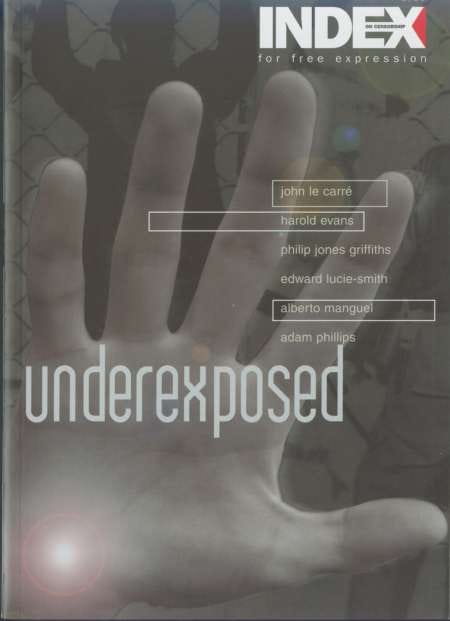
Index on Censorship for Free Expression
Vol 28 No. 6 Nov/Dec 1999 Issue 191
Published by Writers & Scholars International Ltd.,
Lancaster House, 33 Islington High Street, London N1 9LH
Also Available as PDF
In “Forbidden Culture,” Edward Lucie-Smith surveys a century of art censorship — from the shrouding of Oscar Wilde’s tomb sculpture to Duchamp’s Fountain, Nazi Germany’s “Degenerate Art,” and the 1989 Corcoran Gallery cancellation of Robert Mapplethorpe’s retrospective. The issue’s accompanying “Underexposed” photo feature again reproduces Jack Fritscher’s “Mike Welder,” censored a second time from general publication.
Summary: “Forbidden Culture”
Author: Edward Lucie-Smith
Source: Index on Censorship, 6/99 (“Underexposed” issue), pp. 66–68
About the author: art critic and historian; co-author with Judy Chicago of Women and Art (Weidenfeld Illustrated, October 1999)
Citation: Lucie-Smith, Edward. “Forbidden Culture.” Index on Censorship, vol. 28, no. 6 (Nov/Dec 1999), issue 191, pp. 66–68. London: Writers & Scholars International Ltd.
Overview
Lucie-Smith argues that avant-garde art and the urge to censor have become partners. Writing in late 1999, he notes that an editorial in The Times of London defended the Turner Prize largely on the grounds of the uproar it generates, and he takes that as a sign of the times: if nobody wants to ban a contemporary work, it may not be truly avant-garde. He adds that such art is now often backed by official patronage, while opposition to it tends to be populist and sometimes stirred up by the tabloid press. Vandalism by outraged individuals, he says, is destructive but is not strictly “censorship,” which requires the use or misuse of official power.
Early modernist cases
The survey opens with Jacob Epstein’s memorial to Oscar Wilde in Père Lachaise cemetery in Paris. Commissioned in 1908 and installed in 1912, it was covered with a tarpaulin by cemetery administrators who objected to the figure’s genitals. It was unveiled in 1914 with a small bronze cover, which soon vanished, and the monument was later vandalized in 1961 by two women reportedly offended that it drew homosexual pilgrims.
Two further episodes involved sexuality. Marcel Duchamp’s Fountain, a signed urinal submitted to the 1917 Independents exhibition in New York, was removed by a narrow vote after opposition from figures such as the painter George Bellows. Constantin Brancusi’s polished sculpture Princesse X was pulled from the 1920 Paris Salon des Indépendants for its supposed resemblance to a phallus, even though it had been shown in New York without trouble.
Totalitarian censorship
Lucie-Smith dates the real age of censorship in twentieth-century art to the rise of Soviet communism and the Nazi Party. Russian avant-gardists backed the Bolsheviks but found little reciprocal enthusiasm; the charge of “formalism” became a catch-all term of abuse, and the Union of Soviet Artists, founded in 1932, created a system of control that lasted until Gorbachev, with occasional thaws followed by backlash, such as Khrushchev’s outburst at a Moscow exhibition in 1954. In Germany, Hitler, himself a failed painter, drew on Max Nordau’s idea of degeneration to condemn modernists. The 1937 Degenerate Art exhibition in Munich, meant to promote that doctrine, drew more than two million visitors, still a record for a contemporary art show when he wrote.
Postwar patterns
Nazi persecution, he suggests, gave modern art an official status as a symbol of democratic, anti-totalitarian values. Since 1945, censorship episodes have mostly been tied first to sexual representation and second to social tensions within a society. His examples include two 1966 British cases (the prosecution of the Robert Fraser Gallery over Jim Dine’s erotic drawings, and the case against Gustav Metzger over a Hermann Nitsch action) and a run of American cases in the late 1980s and early 1990s: the closure of the Mapplethorpe exhibition at the Corcoran Gallery and the unsuccessful Cincinnati prosecution, the withdrawal of Judy Chicago’s The Dinner Party from a University of the District of Columbia home under funding threats, and the NEA grant denial to Karen Finley, whose lawsuit was settled in her favor in 1993.
Conclusion
Sexual content was at issue in all the American cases, which Lucie-Smith reads as a clash between a neo-puritan revival and constitutional guarantees of free expression. He cautions against framing this as unestablished artists versus official forces, and instead describes it as something closer to a civil war within the establishment itself.
This is an original-wording summary prepared for archive reference. For the full text, see the original publication.