Index on Censorship for Free Expression
Vol 26 No. 4 Jul/Aug 1997 Issue 177
Published by Writers & Scholars International Ltd.,
Lancaster House, 33 Islington High Street, London N1 9LH
Also Available as PDF
In “On Being Censored,” Edward Lucie-Smith recounts how his forthcoming book Ars Erotica ran afoul of British publishing lawyers over its photographic content — despite far more explicit paintings and drawings sailing through untouched. Jack Fritscher’s photograph “Mike Welder” was among the images pulled from the general-audience edition, reproduced instead in the issue’s “Censorship UK” photo feature.
Summary: “On Being Censored”
Author: Edward Lucie-Smith (1933–2026)
Subtitle: Art falls foul of a peculiarly British taboo
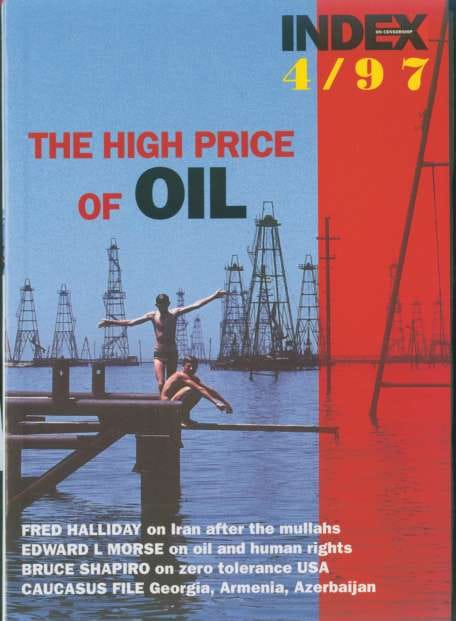
Source: Index on Censorship, 4/97 (“The High Price of Oil” issue), Photo Feature: Censorship UK, pp. 178–180
About the author: poet, writer and art critic; most recent book at the time was ArToday (Phaidon, 1996)
Citation: Lucie-Smith, Edward. “On Being Censored.” Index on Censorship, vol. 26, no. 4 (July/Aug 1997), pp. 178–180. London: Writers & Scholars International Ltd.
Overview
Lucie-Smith, a longtime critic of censorship, describes the odd experience of being censored himself. His forthcoming book Ars Erotica, due from two publishers on either side of the Atlantic, was fully written, illustrated and laid out when the British publisher grew nervous and brought in his lawyers. Their objection was chiefly the number of erect penises in the pictures, specifically in photographs.
Two taboos
He explains why photographs are treated differently from paintings and drawings. In British practice, he notes, almost anything can be reproduced in a painting or drawing, and the further back in time the work dates, the safer it is. Photographs less than fifty years old are another matter. The first taboo is the lingering power of the camera: although everyone understands that digital images can be altered, photographs still seem to certify that the erotic event really happened in front of a witness, which unsettles people. The second taboo he calls peculiarly British, a deep unease about the erect penis, or even any hint of one, which makes otherwise sensible people uneasy. He compares this to Japanese squeamishness about female pubic hair, in a country that nonetheless publishes extravagant erotica.
As a current illustration, he cites a new British television commercial for a perfume in which a woman walks into a life-drawing class and the male model reacts to her scent. Nothing explicit is shown, yet a self-appointed guardian of public morals denounced the advertisement, using a phrase about cultural degeneration that, as he observes, carries its own historical echo.
The negotiation
Once the lawyers had objected, a round of bargaining began over how many erections could be kept. Two images that had already appeared in British books, in 1991 and 1995, and have sold freely in general bookstores since then, were still refused, because those books were aimed at a specialist (that is, homosexual) readership, while Ars Erotica is meant for the general public and covers a wide range of sexualities.
A third, larger image was likely to survive, and the reason is revealing. It looks like a shot from a gay erotic magazine but is actually the work of the celebrated American artist Andres Serrano, whose Piss Christ stirred controversy earlier (covered in Index 3/1996). The picture was commissioned by the Groninger Museum in the Netherlands for its permanent collection, which supplied the transparency. His point is that if you are famous and official enough, you can depict nearly anything, even with a camera, and he adds that Jeff Koons did so in widely distributed books (see Index 2/1995).
A painting under pressure
Beyond the photographs, the publisher also wants to drop one painting, The Flagellation by the New Mexican artist Delmas Howe, from a series of Stations of the Cross. Its composition resembles traditional treatments of the subject, including a violent one by Ludovico Carracci, but Howe’s figures wear leather gear identifying them with the modern gay S&M community, openly linking pain, pleasure and religious feeling. Lucie-Smith notes a further irony: the model for Howe’s Christ is a man who recently won a six-figure settlement from the Roman Catholic diocese of Albuquerque over abuse he suffered as a child at the hands of priests.
Conclusion
As far as the author knows, Howe’s painting remains in the book for now, and he closes by telling readers to keep watching the matter.
This is an original-wording summary prepared for archive reference. For the full text, see the original publication.