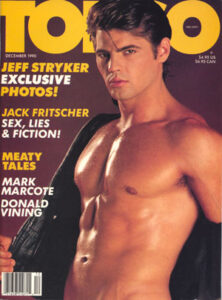
TORSO
Vol 9 No 6 December 1990
SEX, LIES, AND GAY FICTION…
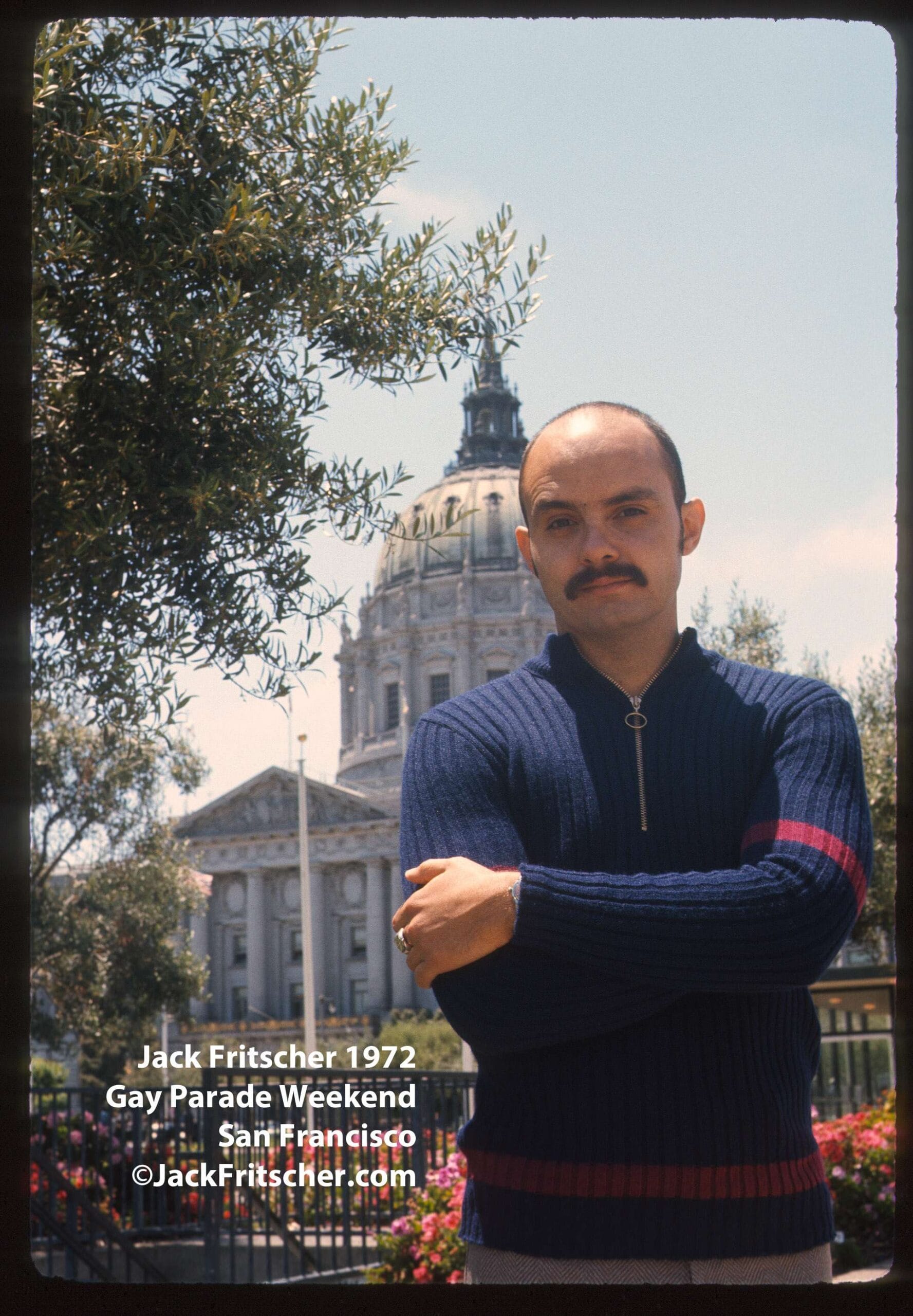
A Candid Interview with Jack Fritscher
by Claude Thomas
Also Available as PDF
Jack Fritscher’s recently published novel, Some Dance To Remember, is set in San Francisco during the gay ’70s, the “Golden Age of the Castro.” It’s a ribald, epic work (562 pages!) that the Bay Area Reporter called “the Gone With The Wind of sexual liberation.”
But Jack Fritscher has always been a prolific writer. He’s the author of over 200 magazine articles and short stories, published in everything from Foreskin Quarterly to the Bucknell Review. A former editor of Drummer magazine, he holds a Ph.D. in American Literature (thesis on Tennessee Williams) from Loyola University. Porn fans will be familiar with his Corporal in Charge of Captain O’Malley, the white-hot S&M adventure first serialized in Drummer.
Fritscher’s official bio credits him with “one play, two novels, two fiction anthologies, and two non-fiction books.” He was also at one time the lover of photographer Robert Mapplethorpe. The man has been around—and now he’s written about it.
Claude Thomas: You’re also known as an erotic photographer and you’ve directed over a hundred erotic videos for Marathon Films, Old Reliable, and Palm Drive Video. What drives you?
Jack Fritscher: Sex and death. Getting enough of one before the other. You can’t cheat death, but you can cheat life if you don’t do what you must do. I can’t help producing stuff. I was born to write.
Claude Thomas: Readers can’t seem to get enough.
Jack Fritscher: I’m sure some people wish I’d just go away.
Claude Thomas: Are you tough on yourself?
Jack Fritscher: I like tough guys. Tough guys get my attention. Bright guys hold my interest.
Claude Thomas: Gays and lesbians have to be tough.
Jack Fritscher: It’s a tough world. That’s why I put a boxer on the cover of Some Dance to Remember. I found that photo in 1984 and instantly wanted it. George Mott photographed this statue in Mussolini’s Foro Italico stadium. Some Dance is one book you can judge by its cover. The statue reminds me of the essence of Kick…
Claude Thomas: Kick gets his name because he has a dick like a kickstand on a bike, right?
Jack Fritscher: Kick’s the Golden Bodybuilder in the story, but the cover photo also represents the stance gays and lesbians need to protect our rights in society.
Claude Thomas: You said Some Dance took twelve years to write.
Jack Fritscher: I wrote it in bits and pieces while I was writing for other magazines. I also was swinging from the chandeliers in the ’70s. Some nights when the baths were slow, I’d sit in my cubicle with the door closed and write until the action picked up. That’s why the original manuscript has Crisco stains on it.
Claude Thomas: You’ve said it’s more than a “gay novel.”
Jack Fritscher: It’s about humans who happen to be gay and straight. It’s an out-of-the-closet, out-of-the-ghetto novel. Having to be in the closet is a form of sexual abuse. Being limited by the title “gay novel,” is a form of literary abuse.
Claude Thomas: It’s definitely a cross-over novel.
Jack Fritscher: Maybe Straight America has a curiosity about what we were like before AIDS.
Claude Thomas: Straight critics have given Some Dance very good reviews.
Jack Fritscher: Yeah. But I don’t write for critics. I write because I have this, uh, nostalgic need to spill my guts about the wonderful first phase of gay liberation. Some Dance is a very emotional book. Well, to me. It’s a very honest book. Very personal. Maybe that’s why readers identify.
I scraped my flesh to the bone to write the passion I witnessed on Castro and Folsom. Some Dance nearly killed me.
Claude Thomas: The media seems to be suddenly very interested in the ’70s.
Jack Fritscher: Because the ’80s were so…Republican. Because the ’70s were a great party time in the U.S. And all the great party animals, say at the celeb Studio 54, who set the popular styles for the ’70s are dead. Mostly of AIDS. Mapplethorpe. Warhol. Halston. Rubell. The list is mythic, and unfortunately endless. Liz and Liza survived. Elizabeth is a Saint of AIDS. Some don’t realize that the ’70s were a gigantic performance piece about human relationships. Everybody did sex and drugs and still created art, fashion, style, wit, and real self-actualizing relationships.
Claude Thomas: So Some Dance has hit at the right time.
Jack Fritscher: Thank the goddess.
Claude Thomas: Your writing has a certain distinct style.
Jack Fritscher: Blame Catholic education. My style comes out of ritualized Latin. Besides, gays and lesbians love to play with language.
Claude Thomas: You really revel in gay style, humor, politics.
Jack Fritscher: I risked writing Some Dance with an edge. It’s not a cliched story about a sensitive soul coming out, falling in love, and then dying of AIDS. It’s a romantic comedy about these sex-obsessed guys.
Claude Thomas: Are you the main character, Ryan O’Hara?
Jack Fritscher: No. And yes. In a sense, all the characters are me, and not me. That’s what writing fiction is. (Laughs) If any character were me, I’d like to have Solly Blue’s acid wit in Kick’s dropdead body.
Claude Thomas: Solly, the porn-video mogul, does very funny, bitchy, intelligent dialog.
Jack Fritscher: We need to laugh. We’re all cried out. Some Dance may be good balance in an age of AIDS. It’s not an AIDS novel, although AIDS enters into it. The time period of the book is 1970-1982.
“I wrote Some Dance in bits and pieces while I was writing for other magazines. I also was swinging from the chandeliers in the ’70s. Some nights when the baths were slow, I’d sit in my cubicle with the door closed and write until the action picked up. That’s why the original manuscript has Crisco stains on it.”
Claude Thomas: The story ends as AIDS is beginning. Why’d you write such an ambitious novel?
Jack Fritscher: Because it’s about a sexually and politically ambitious time. Gay liberation was, next to Vietnam and Watergate, the biggest news of the ’70s.
With a decade of AIDS behind us, I wanted to recall what a good time we all had before the AIDS quake. I wrote Some Dance to Remember first as a thrill ride, the kind of big, luxurious, monster book one can’t put down late at night. The kind of book you read on vacation wearing Speedos and sunglasses.
Mainly though, I wrote it to get our history down in fictional form. It’s necessary for healing that we don’t forget the good times. We must remember our own gay history.
But, hey, I don’t want to be profound here. I kind of hoped you’d be writing this interview for a supermarket tabloid. The only fantasy I have left is to see a National Enquirer headline screaming “GAY AUTHOR WRITES GRATING AMERICAN NOVEL WHILE GETTING FISTED ON CHURCH ALTAR AT MIDNIGHT ON HALLOWEEN!”
Claude Thomas: I hear you may be on Geraldo.
Jack Fritscher: Geraldo, who I hear has pierced nipples, is about the same as the Enquirer. He’d probably hit me with a chair.
Actually, in the ’90s, I think we’re going to see more gays and lesbians featured in mainstream entertainment. Straights have come to their senses. They’re not so much afraid of us anymore. AIDS scared us into invisibility on page and screen. Except for Armistead Maupin and Harvey Fierstein. They’re both very talented writers and clever at presenting homosexuality in a safely comic way mainstream America can handle.
Claude Thomas: Still, there’s Jesse Helms.
Jack Fritscher: Please don’t bring up the Robert Mapplethorpe controversy. I am not the Widow Mapplethorpe.
Claude Thomas: You and Robert were lovers.
Jack Fritscher: Before he became famous.
Claude Thomas: Then what happened?
Jack Fritscher: Robert and I became friends. I was recently interviewed at length by a New York author who is writing the official Mapplethorpe biography for Random House. That was truth, not fiction. She’s reading Some Dance right now to flesh out the background of her Mapplethorpe bio, because it’s the only book out there to fill her in conceptually and historically on what the Gay ’70s were like.
Claude Thomas: Is it true that Robert insisted you write Some Dance to Remember?
Jack Fritscher: That is true. I met Robert when I was Drummer‘s first editor. He was a little known photographer of great talent. He came into my office one day with a great portfolio. Robert was ambitious. He had a life plan. He wanted to shoot a Drummer cover. I needed a good cover. This was 1977. I put him in touch with a model I knew in New York. They hit it off and created a great photograph. Drummer got the cover. We all won.
Claude Thomas: Why did Mapplethorpe want you to write Some Dance to Remember?
Jack Fritscher: He claimed I did with words what he did with photography. He flattered me. He wanted us to do a book together.
Claude Thomas: Why didn’t you?
Jack Fritscher: Writing takes longer than photography. And…Robert became suddenly famous outside gay circles. He was into international society. His exact words were: “You should stop writing for gay rags. You need to hit the mainstream. You need to kiss some straight rich ass and make them think they’re kissing yours. That’s how you get out of the gay ghetto.”
Fact is, I didn’t want out. Not then. Not even now, particularly. I liked the masculine gay bath and leather culture of the ’70s. I never danced…Get it? No disco. I was a nasty boy. Into S&M. I preferred the Everhard, the Mineshaft, the Slot, and the Barracks. Besides, I like, I really like, writing for gay magazines.
“Robert Mapplethorpe’s exact words were: ‘You should stop writing for gay rags. You need to hit the mainstream. You need to kiss some straight rich ass and make them think they’re kissing yours. That’s how you get out of the gay ghetto.’”
Claude Thomas: Robert was a satanist. Are you?
Jack Fritscher: Why does everyone ask me that?
Claude Thomas: You have Charles Manson eyes.
Jack Fritscher: Let me put this to rest. My first nonfiction book was Popular Witchcraft: Straight from the Witch’s Mouth. I’m a journalist. Words are magic. I learned early on, when I hustled S&M, to use language to seduce clients—and the men I wanted. Sex rap, verbal hypnotism, tit play. I’m half Irish. I have the gift of gab. I’ve never understood Silent Sex.
Claude Thomas: Some Dance does have the rhythms of a sex-rap seduction.
Jack Fritscher: As I said, Some Dance to Remember apparently has a kind of emotional appeal to gay and straight readers. Its reception has totally surprised me. Guys who lived the ’70s love Some Dance because it’s a nostalgic trip down Memory Lane. Guys who missed the ’70s, because they were fourteen at the time, seem to like the novel because it gives insight into the way we were during the party that was over by the time they came out.
Claude Thomas: Some Dance To Remember is a long novel, much like a mini-series saga.
Jack Fritscher: I cut 1,500 pages of draft manuscript down to 562 pages. It’s not a slender volume about slender young men. It’s bulked like a bodybuilder, but it’s cut and ripped to make every word work.
As a matter of fact, I wrote Some Dance as a treatment for a movie. The structure is very movie-like. In reels and sequences. Not in chapters. Even the songs and dances are choreographed. Would you believe I wrote, in 1982, the scene where Kweenie sings “Wind Beneath My Wings” a la Bette Midler. And then, eight years later, in 1990, the same week the novel was published, Midler actually won a Grammy for “Best Song of the Year.”
Claude Thomas: Life imitates art.
Jack Fritscher: Weird.
Claude Thomas: Why is Some Dance not an AIDS novel? Every other gay novel that comes out is about AIDS.
Jack Fritscher: You answer your own question. Besides, we didn’t have AIDS in the ’70s. We had fun, sex, politics. I started writing Some Dance eons before the plague. AIDS enters in briefly toward the end, otherwise it would be, as Chris Davis said in his Outweek review, an unbelievable fairy tale.
I don’t think readers need another AIDS novel or play. At the beginning of the plague, we needed that kind of writing to vent our anguish.
In no way do I mean to deny the horror we have all been through. But a decade has passed, killing young men in their prime. My heart aches for the PWA’s, for the deceaseds’ survivors, and especially for all the young talent dying just at the point when they’ve experienced enough life to begin to comment about it. We’ve lost thousands of potential writers, poets, artists, and photographers who never lived long enough to get to that age in life when one begins to analyze and create.
Reagan and Bush should be ashamed. It’s ironic. AIDS gets hardly any government attention, but Robert Mapplethorpe’s photographs have succeeded politically in virtually stopping the government in its tracks. Art is always more scary to fascist fundamentalists than is disease. Because art is about free-thinking.
Claude Thomas: You have a lot of opinions.
Jack Fritscher: All of them subject to change. I’m not a patriarchal authoritarian. I’m a nonconformist.
Claude Thomas: You mentioned that Some Dance has almost as many straight as gay characters.
Jack Fritscher: Women and men. Kweenasheba, I like. Kweenie. She’s the female singer who’s “The Toast of the Castro.” I also like the Vietnam vet and his family. It’s odd how gay readers never mention the straight characters, but straight readers do. I wanted to dramatize an American nuclear family going into meltdown. Talk about disfunctional family values!
Claude Thomas: So you put straight characters in to balance the story?
Jack Fritscher: When I came out of the closet, I entered the ghetto. That’s not enough. For me, as Robert insisted, I had finally to escape the ghetto into life. It’s ironic that many politically correct gays and lesbians want to mainstream the handicapped and refuse to mainstream themselves into American society. The ghetto is just a larger closet that some of us keep ourselves in unnecessarily. I’m not asking for approval from straight society. Just my rights. Fuck ’em.
I came up in the ’50s, a decade when the young, like Ginsberg and the Beats, and then John Waters and Divine, were revolting against conformity. One essence of homosexuality is nonconformity. I don’t ever want to conform to bourgeois American family values. Family, as a buzz word, is what censors and politicians love. That’s why I put into the novel a true picture of an American straight family who lives at the K Mart.
Claude Thomas: So as a nonconformist, you won’t conform to straight or gay lifestyles?
Jack Fritscher: I don’t want a lifestyle. I want a life.
Claude Thomas: Yet you support the concept of a gay and lesbian community?
Jack Fritscher: Of course. A group identity, but with individuality preserved. Self-actualizing people have lives. They discover a sense of themselves. They don’t adopt an identity from a group. That’s the wonderful thing about being gay. Gay people are each our own best creation. We should accept our own diversity within our community and not try to make all gay men and lesbian women conform to some discreet politic of the gay bourgeoisie.
Claude Thomas: So you’re a free-thinker.
Jack Fritscher: I’m a nonconformist. Artists never conform to anything. That’s what makes them artists. Refusing to be politically correct is the only politically correct way of being. Once you buy into institutionalized homosexuality, then you are as lost in the gay bourgeoisie as someone who buys into institutionalized Christian sects or the Republican party.
Actually, I don’t think a person can be homosexual or lesbian and be politically correct. To be gay or lesbian is to be John Rechy’s sexual outlaw. A nonconformist.
Politically correct people tend to be Fundamentalist Gays. You heard it here first, folks. They scare me more than their kindred, Fundamentalist Religionists. Both groups continually thump people with chapter and verse of what they think people should do. To be gay or lesbian is to be a rebel. Even as we grab our civil rights in society we must not let ourselves be assimilated into it. We can live and work within the mainstream, with our rights and our preferences, but we must always rebel against the conformity America wants. Rechy was right, but it’s not just about sexual preference. It’s about thinking free.
Our gayness gives us a parallax view on life. To paraphrase the song, “We’re just rebels and we’ll never ever be any good”—at least not the way society wants us to be. Homosexuality provides an outside eye on heterosexuality. We rebel against fashion and design and government policy, and within a few years straight society follows. We’re gadflies. We also design their clothes, their interiors, and their hair. They need us. Our rebellious innovations keep them provoked and therefore changing and evolving.
“Reagan and Bush should be ashamed. It’s ironic. AIDS gets hardly any government attention, but Robert Mapplethorpe’s photographs have succeeded politically in virtually stopping the government in its tracks. Art is always more scary to fascist fundamentalists than is disease. Because art is about free-thinking.”
We simply have to be careful to coax simple-sighted straights along by demonstrating our common ground while ensuring we don’t buy into their mainstream values like that risible Mr. America, Bob (Plaster of) Paris, who came out on the cover of Ironman magazine and The Advocate talking about his “husband.” Why not spouse? Harvey Fierstein, when he wants to be Donna Reed in a model of a straight family, makes the same linguistic faux pas in Torch Song Trilogy. Hey, words have power. Semantics is empowering.
Claude Thomas: Tell me about Bob Paris’ reaction to Some Dance.
Jack Fritscher: Talk about KVeens! Methinks Mr. America doth protest too much. He wrote me a letter saying he never identified with the “animal” approach to bodybuilding the way Kick and Ryan do. Where was Bobby in the ’70s and the ’80s? Has he never read the “animal” copy constantly current as metaphor in all the muscle mags? “Animal Cross-Training!” I bet La Bob never took steroids either.
Yet he’s held up as a gay role model. Gag me. How many gay men can identify with Bob Paris? You should have read the letters to The Advocate editor after Paris was on the cover! Readers thought him, I think, an imperious snot. His letter proves he’s at least rude. At heart, he’s not part of the gay community. He’s using his coming out for publicity. His image actually hurts us. Still, Mr. America can peddle his kitchy-koo according to his own free choice. He’s such a disappointment.
Claude Thomas: So Some Dance is not your memoirs?
Jack Fritscher: I had to be in San Francisco and New York in the ’70s to write it, but it’s not a memoir. My memoir will be a ballbuster compared to the musical comedy of Some Dance.
Claude Thomas: Yet part of its popularity is that everyone is playing “Guess Who” with the characters.
Jack Fritscher: It’s not a kiss-and-tell book. I’m not Nancy Reagan.
I try to depict life and fantasy as they truly are. Or as they truly were, at least my version of what I observed during the Dream Time before the A-word. I was a spy—in an era when everyone was a star.
* * *
Some Dance to Remember is available from Knights Press, 190 Henry St., Stamford, CT 06902 ($11 plus $4 postage and handling).