Curating the Gay Gaze
by Andy Campbell, PhD

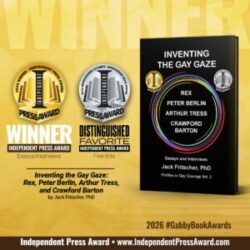
Winner: Independent Press Award – “Essays and Interviews”
Distinguished Favorite: Independent Press Award – “Fine Arts”
Introduction
What to say about Jack Fritscher’s role in leather culture that hasn’t already been said? What about his own gay gaze? In him we still (thankfully) have one of our greatest living leather writers and New Journalists. At 85, he is an embodiment of what decades of observant living and mindful scholarship may offer to new generations. As his fellow writers and artists and photographers who invented the 1970s genre of homomasculine words and images will tell you, such foundational work is done for love not money. The prolific author’s psychic income of earned respect comes from the numerous art and alt-communities he fostered during his 65 years of documenting and reporting leather lives in his books; feature articles, and fiction in the leather bible of Drummer magazine which was a first draft of leather history.
Luckily and happily, Fritscher, the tenured university professor who taught creative writing and film in the turbulent 1960s, is a writer who is an artist finely attuned to art, and to all the trappings of that wayward, difficult calling to create visions against all the odds of straight and gay censorship. In this book, as editor-in-chief of Drummer (1977-1980), and on screen, as co-founder and director of Palm Drive Video, he reveals how evolving visual artists invented the gay gaze. Recalling his unique community eyewitness position as editor, he says it was the centrality of Drummer itself that gifted him personal access to artists seeking publication.
The multi-award-winning author is a Lambda Literary Finalist whose 1994 memoir of his bicoastal lover, Mapplethorpe: Assault with a Deadly Camera, is one of his twenty books chronicling the first post-Stonewall generation of artists and photographers including in this book: Rex, Peter Berlin, Arthur Tress, and Crawford Barton. As an intimate of Mapplethorpe, he is uniquely qualified to stir Robert’s eye, attitude, and ubiquity into this book of competitive peers. Fritscher, clearly relishing the task of putting language to page, is a pleasure to read. Rollicking, fun, sexy, provocative, and heartfelt, he entertains and informs by opening his deep archives and journals as portals to the past.
He lets the unfiltered artists speak for themselves in their own authentic voices in these interviews of oral history. In this book, the third volume in his series Profiles in Gay Courage: Leatherfolk, Arts, and Ideas, these vivid profiles offer readers a basic introduction to the artistic practices of fine artists and photographers who helped create and develop the postwar queer eye in gay media. For this task, Fritscher culls his archive of writing, interviews, missives, and his own journal memories. His point of view canonizes his iconic friends by presenting their specific origin stories within the context of general gay history.
In these profiles of four artists who started up before Stonewall, flourished in the 1970s, and carried on as influencers despite AIDS to the end of the century, Fritscher is in top form. In his annotated interviews, he writes a paean to the reclusive pointillist artist Rex who asked him to write his uncensored eulogy.
In his interview with photographer Peter Berlin on Berlin’s 80th birthday, Berlin, speaking under his birth name, Armin Heune, tells how he created his famous alter-ego by refining his gaze both in camera and in post-shoot enhancements.
In his intense chat with ethnographic photographer Arthur Tress, Tress explains using the magical realism of mid-century modernism to develop and frame his unique perspective.
In his conversation with Crawford Barton who was the key photographer of 1970s Castro Street, the dying Barton recalls how he escaped from the homophobic American South to the sanctuary of San Francisco where he developed his multiracial street gaze around the platonic ideal of all kinds of new male beauty.
The coverage of these four essential visionaries will interest readers of gay popular culture, photo historians, and scholars tracking the shifting visual codings of gay life. Taken together these essay-interviews consider the many ways that art moves the mind, body, and the relational feelings we have towards one another.
A new generation of readers may enjoy this book by an eyewitness survivor of the twentieth century.
—Andy Campbell, PhD, author of Queer X Design: 50 Years of Signs, Symbols, Banners, Logos, and Graphic Art of LGBTQ Pride and Activism, is Chair and Associate Professor of Critical Studies at USC’s Roski School of Art and Design