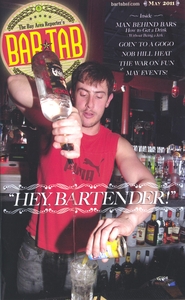
“Star Barkeep (Tony Tavarossi)”
by Jack Fritscher
Born to be a bar star in the Mission District (1933), Tony Tavarossi came out at age twelve giving blow jobs under the tables in the curtained booths of the South China Café at 4133 18th Street and Castro. It was war’s end: 1945. San Francisco surged with carousing soldiers and sailors. As a rebellious Catholic boy, Tony relished being a Sagittarius archer hunting masculine wild things. Cruising waterfront bars that would soon be demolished for the new Embarcadero Freeway, teenager Tony became a one-man USO, learning a lesson on his knees about entertaining the troops.
Long before turning 21, he worked bars in the 1950s Tenderloin, instinctively absorbing management skills and attracting the attention of a Mafia guido who squired him in 1959 to fly to New York to see if the rapidly masculinizing “hard” bars might translate to lyrical San Francisco. Not “connected” because he was gay, Tony was nevertheless an Italian with “backing.” He reckoned that the new bar concept would travel. Popularly known for his BDSM games, his bar ideas were commercial extensions of private sexuality: performance stages where players could both lose and find themselves in backroom gloryholes with slings. So in 1961, age 28, coding his name backwards, he became the “owner” of San Francisco’s first dedicated leather bar, “Tony’s Ynot?” In 1962, the SFPD closed the Ynot when Tony himself was entrapped in his own bar. That arrest, contributing to the founding of the Tavern Guild (1962), made him, like Jose Sarria, a popular local personality years before the rebellions at Compton’s Cafeteria (1966) and Stonewall (1969).
San Francisco was awakening. North of Market Street, the neon Tenderloin was too policed. South of Market, the dark industrial area looked outlaw. The leather crowd migrated from NoMa to SoMa. In 1962, having promised sex-tourist Chuck Arnett a job during the run of the Ynot, Tony found him other work when in 1963 the Louisiana-born Arnett returned to San Francisco. Expert at networking, Tony steered him forward to a creative job at the Tool Box. Having apprenticed under leather artist Etienne at Chuck Renslow’s Gold Coast bar, Arnett debuted by painting his iconic mural and became the star artist of Folsom Street even as Tony became a star serving on the creative crews of nearly every bar and bath South of Market in the Swinging 1960s and Titanic 1970s.
With other players crashing in the hippie-leather flat over the Stud bar near Fe-Be’s, Arnett imported the psychedelic drugs of the Haight-Ashbury to Folsom Street. During the sex wars of gay lib, bartenders often prescribed the recreational medication needed to survive the battles. Dispensing purposed party favors in bars, Chuck and Tony introduced fisting as a new sport. According to bar stories, Tony had been one of the first men fisted in recorded modern times. In fact, he told me that in 1960, two Marines had hung him upside down in a shower in an Oceanside motel and plunged on in through his cherry. By 1963, Jack and Tony were hosting fisting parties at 111 Gilbert Street in a SoMa warehouse where Jack’s father cleaned and restored used refrigerators and stoves. By 1974, Tony was tutoring newcomer Steve MacEachern who opened his legendary Catacombs fisting palace in May 1975. In 1977, I shot Super-8 films of Tony fisting a bottom tied butt-up in the wooden stocks in room 226 at the Slot. Folsom Street sexuality rode on Tony’s fist and forearm. In the free spirit of the times, he liked nothing better than seducing “virgins” into anything they had never done before.
In 1978 when the SFPD asked me as the editor of Drummer to take the current crop of police rookies on a “freshman orientation” tour of Folsom Street, I arranged with Tony to give them some sensitivity training at the Slot Hotel. When Tony on the loudspeaker announced as a courtesy that the expected police were in the house, the doors of nearly every room opened fast and wide with exhibitionist leather twosomes and threesomes competing to be outrageous. Halfway through the fifteen-minute tour, one of the young cops swooned and his buddies carried him to the lobby to revive him, but when he came to, he was still in the Slot and Tony was holding a wet cloth to his face, and he fainted again to much laughter.
For eleven years (1970-1981), Tony and I were friends and sex playmates. I adored Tony’s allure. At a swarthy 5-5, 130 pounds, uncut, he was a bearded Sicilian Pan without limits. His natural sensuality was rooted in his infancy thanks to his mother who soothed his sweet temperament by rubbing olive oil circles slowly between his cock and his beautiful Italian foreskin. Living in a scrupulously clean apartment with a wild playroom at 288 Central Avenue at Oak Street, he was a bottom specializing in “topping tops to renew them” as long as they at least tried to top his redoubtable rear in return: fist for fist. That bar-culture cover story “saved face” for his tricks and made him the most popular bartender in town. His tip jars overflowed. Apace with Gertrude Stein, his apartment was filled with drawings, paintings, and photographs from the salon of his creative friends, and from his erotic fans. Lou Rudolph, who was famous for sketching men in Folsom bars, often inked Tony on his large archival watercolor pads.
Tony was a sweet, romantic man, unspoiled by American education. At our first meeting in 1970, he frightened me, the teacher, because he was six years older and was far more pagan, street smart, and sexually sophisticated. I was ashamed that I noticed he was from the underclass and I was middle-class. It took nearly six months of watching him as a bartender beloved in public spaces for me to get over my class consciousness and surrender to his Dionysian style of primal sex. Savvy bartenders always know what’s new and what’s next, and Tony tutored generations of bar workers during his thirty years of active service. His imprint may still be felt.
After four years of playing together and learning each other’s transcendental turn-ons, he wrote me a love note which he hand delivered. In all its longing sincerity, the note reads as if he were channeling Chaucer from a wilder “medieval” past. Why not toy with some over-thinking? From 1967 on, bar jukeboxes played Procul Harum quoting the “Miller’s Tale” in “A Whiter Shade of Pale.” And wasn’t Harry Bailey, the host in The Canterbury Tales, a bartender? No wonder that Edward III rewarded Chaucer “with a gallon of wine daily for the rest of his life.”
Somthing To Think about;
I would like to have you see me in pain!
Having you see me, and hereing me in Pain.
To see the sweet balls Pop all over me, and
to smell the Pain grow in me more, and more.
Mouth should drink from your juice cock, and
see you sit on my mouth as I ake in Pane.
Having my tongue dig in to you
as you show more parts of me to feel you.
Your ass should muffel my crys, and
having me suck on your ass hole and
when my cock sit up and hard,
Your hands and mine will Tuch my sole and
dance on my braine and you will know
that I am a brother of Pain and
you are the giver of Pain. And
in that I will show you my love of you and
Please you if you let me.
—Tony
In 1981, the fabled Barracks baths burned down slamming the Titanic 1970s to symbolic close. Tony had worked at the Barracks and its Red Star Saloon. Collapsing with shingles and shigella, he had been admitted to San Francisco General where I visited him in ICU. Unable to speak, he was alert. Because one Barracks manager had crossed him, I tried cheering him with the karma he loved: “The Barracks burned down yesterday. It’s the end of an era.” Reaching for pencil and paper, he scrawled, “Good.” In the hall, I asked his doctor, “What’s wrong with him?” She said, “We don’t know. We’ve never seen a patient so distressed.” No one had yet heard of AIDS. Tony Tavarossi died the next day, July 12, 1981. He was loved. His funeral was enormous.
In 2010 when the San Francisco Planning Commission queried me for suggestions about recognizing and protecting the GLBTQ social heritage of South of Market, I suggested that a street might be named to honor Tony Tavarossi who for all the fun and games was one of those bartenders who are front-line caretakers of gay society. Find more about Tony at www.JackFritscher.com. © 2011 Jack Fritscher, author of the award-winning history Gay San Francisco.