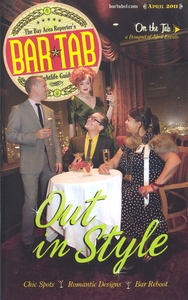
“Gay by Design”
Interior Design: The Apartheid of Gay Bars
by Jack Fritscher
Gay bars are like Mickey and Judy putting on a theme show in the barn. In the way the world did not begin the day you first noticed it, gay bars did not begin the night you came out and chose the venue whose form fitted your “funktion” best. Even as gay male leather bars and hustler bars existed under the 1930s radar, piss-elegant bars were de rigueur back in the art deco days of classic San Francisco, and the pissier, the gayer. When straightlaced hotels chased gay wallets, the very apartheid design of the bar signaled straight or gay.
Late in the Depression 1930s, the St. Francis Hotel on Powell Street, abandoning the “Victorian gentlemen’s club” of dark wood paneling, fetched up gay cash with its outlandish “Orchid Room,” swank, with a narcissistic interior design marketed smartly as “Lavender glass and black kid leather. When Noel Coward writes another play, or smiths another tune like ‘Mad Dogs and Englishmen,’ go here to talk about it…It’s a hundred thousand bucks worth of glitter. The walls are black kid, the ceiling is DuPont’s new translucent Lucite…Ceiling-to-floor mirrors are spotted around where you can sneak a look at yourself when you’re feeling your cleverest. The floor is turquoise-rugged. The whole joint changes color according to whim.” Lavender? Kid leather? Lucite? Mirrors? Turquoise carpet? A light mixer? You’re not in Kansas, sailor! You’re in a gay bar. And it’s not the leatherish interior of the “Sailor Boy Tavern” founded in 1938 on Steuart Street near the Embarcadero YMCA. Welcome to World War II!
In that run-up to the great sex adventure that was WWII for boys you couldn’t keep down on the farm, the designers of the 1939 San Francisco World’s Fair on Treasure Island built a notable construction, a temporary tavern, coyly called the “Gayway” whose fatuous name and art deco exterior, crossed with the fair’s midway carnival lights, delivered a hot interior design theatricalizing camp with “live nude cabaret” which was quite a bit sexier than the petit bourgeois drag shows at San Francisco’s world-famous Finocchio’s (1936) and that other unsung treasure, the Beige Room, where the stage runway itself was the heart of design typical for drag presaging the designer shows of today’s Fashion Week.
With the San Francisco GLBT Historical Society catching up on its housekeeping, archivist Marjorie Bryer rummaging recently through a box donated in 1999 found some “lost” black-and-white photographs and negatives of drag performers at the Beige Room in the 1940s and 1950s. Those photographs themselves valuably help reveal the surround of interior design. While “piss elegance” featuring Victor/Victoria to a dapper audience may have ruled north of Market Street, in the Tenderloin and South of Market, darker forces out of the War embraced the dirty Freudian Id of men celebrating man-to-man masculine identity and desire.
It’s worth noting that the first leather bar in the world, the archetypal Argos in Amsterdam, was, in fact, rather much designed by skirting Dutch law in the early 1950s when the government ruled that the owners could not run a public bar. Good leather queens, the owners bought the building and defiantly turned their minamalist bar into the living room of their home with a passage that led back into their larger house where they escalated the emerging maximalist leather scene by renting rooms by the hour in what became the legendary Argos Hotel where in the 1960s I lived for a time, enjoying sex in the basement which, for easy hosing, is blacktopped like a road that I documented in an erotic video feature I shot in that famous cellar in 1989. Similarly on Folsom Street in 1971, Chuck Arnett whose design of the Tool Box was featured in Life magazine, June 1965, designed the intricate hippie redwood-lath interior of the Red Star Saloon with a door leading back to the three-story heaven of the Barracks baths which famously bookended the Titanic 1970s when it burned down on July ___1981 just exactly as AIDS was first on the TV news. (633 Words)
Whatever a patron’s taste or sexuality, gay bar design functions as theatrical stage magic until the music stops and the last-call lights go up like halogen flashlights in a cop raid revealing the minimalist design of the boxy space that somehow looks like a whore’s garage, where usually invisible barback runners suddenly barge in, quickly clearing beer bottles to clean the joint, and you flow with the carousing stream, exiting toward the door to the sidewalk where you stand blinking, sizing up the cruising potential, wondering who you’ll wake up next to naked, blinking against getting real-world bearings in pools of streetlight, looking for your car, your keys, your wallet, your phone, your taxi, leaving the raucous band of people you only see in bars: wonderful, magical, transformative bars whose magical interiors only exist at night and make you believe that you are all that you want to seem! © 2011 Jack Fritscher, San Francisco historian at www.JackFritscher.com.